
Article by
Chris Niblett
With over 28 years of experience in IT and pre-sales roles, my transition into the hospitality and retail sectors has enabled me to help businesses of all sizes optimise their electronic payments and EPOS systems. My passion for service-driven solutions led me to create PenguinPay, where I provide tailored solutions that drive business success.
What if the bank account you have relied on for years is now the primary bottleneck stifling your firm’s agility? Many UK directors find themselves tethered to legacy institutions, enduring high transaction fees and disjointed EPOS integrations because the alternative feels too risky. It’s natural to worry that a transition might lead to missed Direct Debits or disrupted cash flow. However, the reality of switching business bank accounts UK in 2026 is far more sophisticated and supportive than you might expect.
We’ll show you how to leverage the Current Account Switch Service (CASS) to ensure a stress-free, seven-day transition that protects your reputation. This guide explores how a strategic banking move can reduce overheads and create a bespoke synergy between your accounts and payment processing. We’ll examine the latest 2026 incentives and digital tools designed to provide the precise financial clarity your business deserves.
Key Takeaways
- Understand how the Current Account Switch Service (CASS) provides a guaranteed, seven-day transition that automatically redirects payments and protects your business from operational disruption.
- Evaluate whether traditional high street institutions or digital-first challenger banks offer the best bespoke tools for the unique digital demands of the retail and hospitality sectors.
- Discover why switching business bank accounts UK presents the ideal strategic opportunity to audit your merchant statements and integrate your EPOS systems for improved financial visibility.
- Learn how to align your new banking partner with modern card payment solutions to reduce transaction fees and optimise your long-term cash flow.
Navigating the Current Account Switch Service (CASS) in 2026
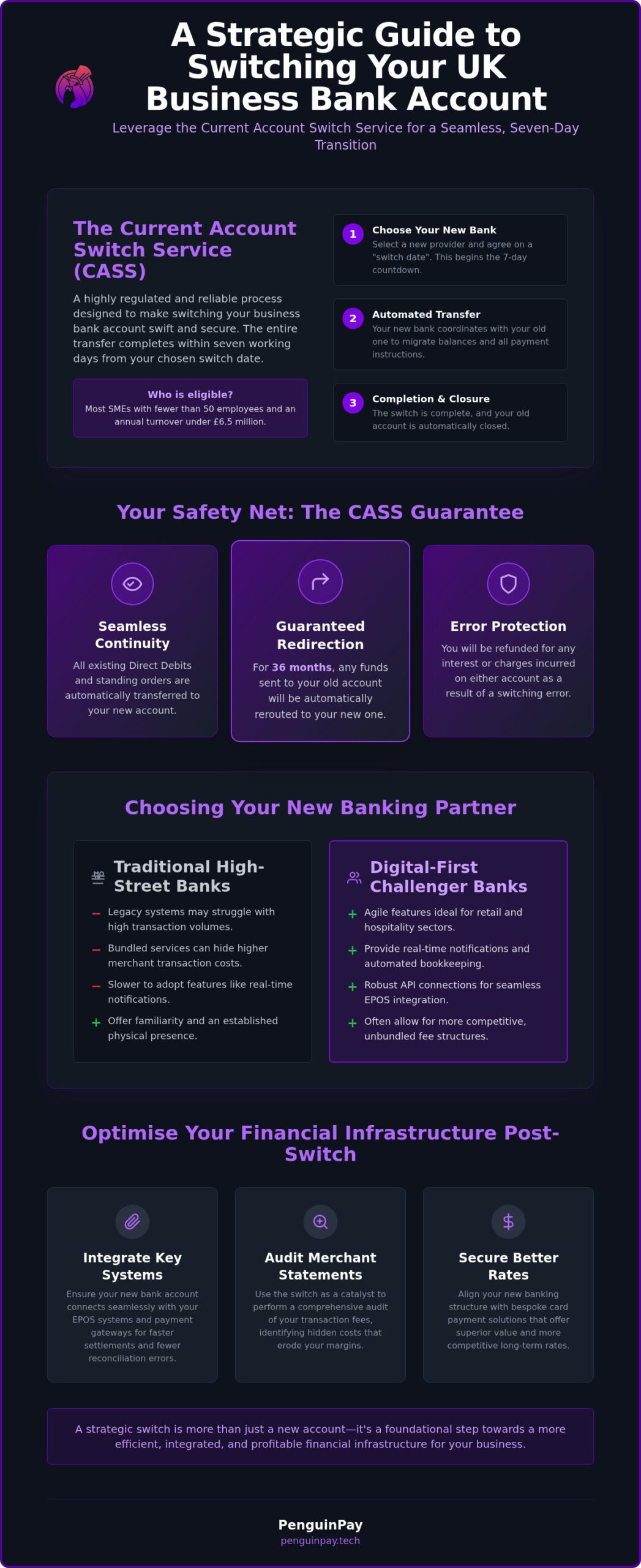
The process of switching business bank accounts UK has been refined into a highly regulated, reliable operation. At its core is the Current Account Switch Service, an initiative originally overseen by Bacs Payment Schemes Limited, which ensures your transition is both swift and secure. For most SMEs, including those with fewer than 50 employees and an annual turnover under £6.5 million, this automated service removes the administrative burden of manual data entry.
The timeline is strictly mandated. Once you choose your “switch date,” the entire transfer completes within seven working days. During this window, your new provider coordinates with your old bank to migrate your balance and payment instructions. When selecting a new partner, it is beneficial to review established banking providers that align with your specific industry needs. You must remember to download at least twelve months of historical statements before the switch, as your new bank won’t typically inherit your previous transaction digital archives.
The 7-Day Guarantee: What Stays and What Moves
The CASS Guarantee acts as the primary safety net for UK SMEs by ensuring any interest or charges incurred due to switch errors are refunded. This protection covers several key operational areas:
- Automatic Transfers: All existing Direct Debits and standing orders move to the new account.
- Payment Redirection: Funds sent to your old account are rerouted for 36 months.
- Seamless Continuity: Your new bank informs your creditors of the change.
This structured approach allows you to focus on core business operations whilst your financial infrastructure updates seamlessly in the background.
Beyond the High Street: Choosing a Bank for Your Specific Industry
Traditional high-street banks often rely on legacy systems that struggle to keep pace with the rapid transaction volumes found in the hospitality and retail sectors. Whilst these institutions offer familiarity, digital-first challenger banks frequently provide more agile features; these include real-time notifications and automated bookkeeping. When switching business bank accounts UK, it’s vital to consider whether a provider’s digital interface supports your daily operational rhythm. For firms across London or the Midlands, the decision often balances digital efficiency with the need for reliable, expert advocacy.
Your choice of bank can significantly influence your merchant service rates. Many established banks bundle services, which might seem convenient but often hides higher transaction costs. By contrast, an independent approach allows you to secure more competitive margins and tailored fee structures. If you feel overwhelmed by these institutional options, you might speak with a consultant to evaluate which banking infrastructure best supports your specific business model.
Evaluating Integration: Banking, EPOS, and Card Payments
The synergy between your bank and your hardware is paramount. A well-chosen account facilitates faster daily settlements, ensuring your cash flow remains fluid and predictable. Modern providers offer robust API connections that link directly to fully integrated EPOS systems, reducing manual reconciliation errors. Before committing, verify your bank’s status with the Current Account Switch Service to ensure the technical migration of your payment instructions is handled with precision. This level of integration is what separates a mere bank account from a strategic financial asset that drives growth.
Optimising Your Financial Infrastructure Post-Switch
Once you have completed switching business bank accounts UK, the work of true financial optimisation begins. This transition provides the perfect catalyst for a comprehensive audit of your merchant statements and overall payment efficiency. Many businesses discover that legacy transaction fees have quietly eroded their margins over several years without being questioned. By reviewing these costs alongside your new banking structure, you can identify hidden inefficiencies and align your accounts with bespoke card payment solutions that offer far superior value.
Managing the technical implementation of these changes requires a methodical, expert approach. PenguinPay specialises in guiding businesses across Derby, Nottingham, and London through these complex financial transitions. We ensure that your new banking partner integrates perfectly with your existing payment gateways and virtual terminals. This prevents the common technical friction that often follows a major move, ensuring your staff experience no downtime whilst your systems update.
Professional Consultancy: Making Your Bank Account Work Harder
Independent advice is invaluable in a landscape crowded with complex banking products and generic, bank-led incentives. A professional consultant helps you move beyond a transactional relationship to a strategic one. We focus on consolidating your banking, business funding, and card payments into a single, efficient strategy that maximises your operational visibility. This holistic view ensures that every component of your financial infrastructure is working in unison to support your long-term growth and resilience. By leveraging over 28 years of IT and pre-sales experience, we help you navigate the nuances of modern finance with confidence. To begin this process, you can speak with our experts to organise your bespoke financial strategy.
Securing Your Financial Future Through Strategic Integration
A well-executed transition does more than reduce monthly fees; it acts as a catalyst for total operational refinement. By leveraging the protections of the Current Account Switch Service, you ensure a secure move whilst creating the space to audit your merchant statements and EPOS efficiency. Switching business bank accounts UK in 2026 is a strategic opportunity to align your banking with bespoke card payment solutions that truly support your daily cash flow.
Chris Niblett utilises over 28 years of IT and pre-sales experience to provide the expert advocacy your firm requires. We offer specialist knowledge for the hospitality and retail sectors, ensuring your financial infrastructure is both robust and agile. When you’re ready to move beyond generic bank-led incentives, Contact PenguinPay for a Bespoke Financial Infrastructure Audit. We look forward to helping you build a more resilient and profitable business model.
Frequently Asked Questions
Is it free to switch business bank accounts in the UK?
Yes, the Current Account Switch Service is a free facility provided to eligible UK small businesses. There are no hidden charges for using this automated process to move your balance and payment instructions. Whilst the service itself is free, you should always check if your current bank applies any specific closing fees for products held outside the standard current account.
Will switching my bank account affect my credit score?
Opening a new account typically involves a formal credit check, which may cause a minor, temporary dip in your credit score. This is a standard procedure when switching business bank accounts UK firms undergo. Over the long term, demonstrating responsible management of a new, more efficient account often helps strengthen your firm’s overall financial profile and creditworthiness.
What happens to my card machine and EPOS system when I switch banks?
Your card machine and EPOS hardware are generally independent of your bank account, but you must update your settlement details. If you use a fully integrated system, you’ll need to re-link your new account to ensure daily takings are deposited correctly. This is the ideal moment to audit your merchant services to ensure your banking and payments are perfectly synchronised.
Can I switch my business bank account if I have an outstanding loan or overdraft?
You can still switch, but any outstanding overdraft must be cleared or transferred to your new provider if they agree to offer a similar facility. Loans often remain with the original lender, requiring you to maintain a separate payment arrangement. It’s vital to discuss these liabilities with your new banking partner early in the consultation to ensure a smooth transition.