

Article by
Chris Niblett
With over 28 years of experience in IT and pre-sales roles, my transition into the hospitality and retail sectors has enabled me to help businesses of all sizes optimise their electronic payments and EPOS systems. My passion for service-driven solutions led me to create PenguinPay, where I provide tailored solutions that drive business success.
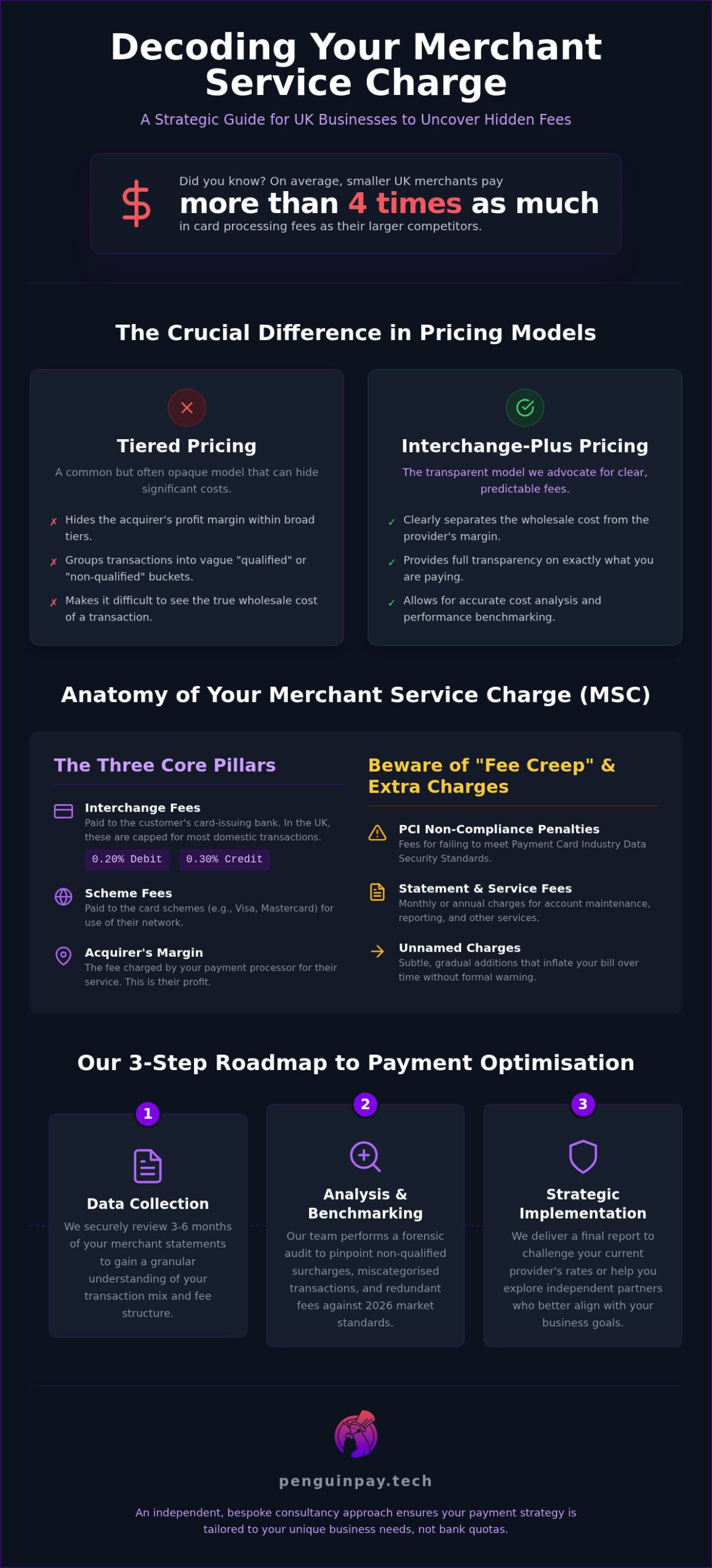
Did you know that smaller UK merchants pay, on average, more than four times as much in card processing fees as their larger competitors? It’s a frustrating reality for many business owners who find themselves staring at a Merchant Service Charge invoice that feels intentionally designed to be unreadable. You likely suspect that fee creep is eroding your margins; yet finding the time to perform a technical line-by-line audit feels nearly impossible whilst managing daily operations. This guide offers merchant account fees explained UK businesses can rely on, showing you how a bespoke statement audit can uncover hidden charges and rectify billing errors. We’ll break down the complexities of processing costs into a jargon-free strategy that reduces your monthly overheads and restores your peace of mind. By the end, you’ll understand how to transform your payment setup into a lean, professional asset that supports your long-term growth.
Key Takeaways
- Identify the structural differences between tiered and interchange-plus pricing to uncover hidden margins within your Merchant Service Charge.
- Discover how a forensic six-month statement review can pinpoint miscategorised transactions and technical billing errors that impact your bottom line.
- This guide offers merchant account fees explained UK businesses can use to benchmark their current processing costs against the latest 2026 market standards.
- Learn why an independent, bespoke consultancy approach ensures your payment strategy is tailored to your unique business needs rather than bank quotas.
Understanding Merchant Account Fees: What UK Businesses Actually Pay
A merchant account is the essential foundation for accepting card payments, yet the associated costs are rarely straightforward. These fees represent the cumulative expenses your provider charges to process every transaction, usually presented on your statement as a Merchant Service Charge (MSC). To get merchant account fees explained UK operators must look beyond the headline rate. Many providers still favour tiered pricing models, which group transactions into “qualified” or “non-qualified” buckets. This structure often hides significant profit margins for the bank. We advocate for interchange-plus pricing instead, as it provides the transparency required to see exactly what you’re paying above the base wholesale cost.
Be vigilant regarding “fee creep.” This refers to the subtle, gradual addition of small, unnamed charges that inflate your monthly bill without any formal warning. Automated billing systems often overlook these discrepancies. A professional, human-led audit is the only way to identify these incremental costs that quietly erode your profitability over several years.
The Components of Your Merchant Service Charge (MSC)
Your MSC is built upon three core pillars: interchange fees, scheme fees paid to Visa or Mastercard, and the acquirer’s margin. In the UK, domestic interchange fees are currently capped at 0.20% for debit cards and 0.30% for credit cards. Beyond these base costs, statements often include “extra” charges such as PCI non-compliance penalties, statement fees, and minimum monthly service charges. These layers of cost are particularly complex within business banking for hospitality. High transaction volumes and a mix of domestic and international cards mean that even a tiny error in how a fee is applied can result in thousands of pounds in lost revenue over a single year. For restaurant operators, understanding these costs alongside your broader business funding for restaurants strategy is essential to maintaining healthy cash flow through seasonal fluctuations.
How a Merchant Statement Audit Uncovers Hidden Costs
An audit serves as a forensic examination, scrutinising your last three to six months of data to identify miscategorised transactions that quietly drain your revenue. Whilst many providers offer a generic overview, our process benchmarks your current rates against 2026 UK market standards to reveal exactly where you’re being overcharged. This is more than just a cost-saving exercise; it’s a strategic health check. Often, high fees stem from outdated hardware or manual entry errors, highlighting the value of Fully Integrated EPOS systems that automate data flow and reduce risk profiles. For those seeking a comprehensive guide for small businesses, understanding these technical nuances is the first step toward reclaiming your margins.
Our Step-by-Step Roadmap to Payment Optimisation
We’ve developed a methodical approach to ensure every merchant account fees explained UK review delivers tangible results. Our roadmap follows three distinct phases to ensure no stone is left unturned:
- Data Collection: We securely review your recent statements to gain a granular understanding of your specific transaction mix and card types.
- Analysis and Benchmarking: Our team identifies non-qualified surcharges and redundant service fees that are often specific to the hospitality or retail sectors.
- Strategic Implementation: We use the final report to challenge your current provider’s rates or explore independent payment partners who better align with your operational goals.
If you’re ready to stop the “fee creep” and secure a more transparent financial future for your business, you can request a bespoke statement review today to begin the process.
The PenguinPay Advantage: Bespoke UK Consultancy
Choosing the right payment strategy requires more than a simple comparison tool. Whilst automated platforms offer a surface-level glance at rates, they lack the nuanced understanding of complex hospitality or retail environments. As an independent consultancy, we prioritise your operational needs over bank quotas. This autonomy allows us to offer merchant account fees explained UK businesses can actually use to drive growth. Led by Chris Niblett, our approach is built on over 28 years of IT and pre-sales experience. This technical background is vital for identifying the intricate billing errors and misconfigurations that standard automated audits frequently overlook.
We believe that local expertise matters. For businesses operating in London, Nottingham, or the wider Midlands, having a partner who understands the regional market provides a significant advantage. We don’t just provide a one-off report; we act as a strategic guide to ensure your payment infrastructure evolves alongside your business. This personalised advocacy ensures you aren’t just another number in a bank’s ledger.
Local Expertise for London and Midlands Merchants
Our strategic partner spotlight ensures we stay connected with the most innovative and competitive providers in the UK. By maintaining these deep industry relationships, we source tailored solutions that a traditional high-street bank simply cannot offer. The long-term benefit of this partnership is sustained optimisation. As your transaction volume increases or you expand into new locations, we continue to monitor your statements. This proactive oversight ensures your margins remain protected from fee creep, providing the clarity of merchant account fees explained UK operators need to scale with confidence.
Secure Your Business Margins with Professional Oversight
Managing merchant services doesn’t have to be a source of constant frustration. By understanding the mechanics of your statement and identifying hidden “fee creep”, you can reclaim significant overheads that otherwise drain your profitability. This guide has provided merchant account fees explained UK businesses can use to transition from opaque billing to a transparent, strategic payment model. We leverage over 28 years of IT and payment expertise to provide completely independent, unbiased consultancy. Our team specialises in supporting merchants across London and the Midlands, ensuring your business receives the boutique-style attention it deserves.
It’s time to stop overpaying and start optimising. Book Your Bespoke Merchant Statement Audit with PenguinPay today to gain total clarity over your processing costs. We’re here to help you build a more resilient and profitable future.
Frequently Asked Questions
What exactly is a merchant statement audit and how long does it take?
A merchant statement audit is a forensic examination of your previous three to six months of transaction data to identify billing errors, miscategorised cards, and hidden “fee creep”. Once we receive your statements, the initial analysis typically takes around three to five working days. This process provides a clear roadmap for optimisation without disrupting your daily business operations or customer service.
How much can a typical UK business save by auditing their processing fees?
Savings depend on your current transaction volume and pricing model, but many merchants find significant reductions in their monthly overheads. With the average cost for UK merchants to accept card payments sitting at approximately 0.6%, those on older, tiered contracts often pay much more. Our merchant account fees explained UK review focuses on aligning your rates with 2026 market standards to recover lost margins.
Do I need to switch my bank to benefit from a merchant account review?
You don’t necessarily need to switch your current provider to see a benefit. The audit report serves as a powerful negotiation tool that you can use to challenge your existing bank’s rates. Whilst switching to an independent partner often yields the highest savings, simply correcting technical billing errors or reclassifying transaction types can reduce costs whilst keeping your current banking relationship intact.
What documents are required to begin a professional payment strategy audit?
To begin a comprehensive audit, you’ll need to provide your most recent three to six months of merchant statements. These documents contain the granular data required to analyse your Merchant Service Charge, terminal rental costs, and any additional PCI compliance fees. Providing a full sequence of statements allows us to identify seasonal trends and ensure our merchant account fees explained UK strategy is tailored to your specific business needs.