

Article by
Chris Niblett
With over 28 years of experience in IT and pre-sales roles, my transition into the hospitality and retail sectors has enabled me to help businesses of all sizes optimise their electronic payments and EPOS systems. My passion for service-driven solutions led me to create PenguinPay, where I provide tailored solutions that drive business success.
If your customers could tap and pay for a £500 transaction as effortlessly as a coffee order, would your peak-hour queues finally vanish? Following the FCA’s decision to remove the £100 contactless limit in March 2026, the selection of contactless payment solutions for business has evolved into a strategic priority rather than a simple hardware choice. You probably recognise the tension that builds when slow processing speeds or confusing merchant fees disrupt your daily operations. It’s a common challenge, but one that yields to a structured, consultative approach.
This guide promises to demystify the transition to modern systems, ensuring you can reduce transaction friction whilst maintaining robust security. We’ll examine how to deploy Fully Integrated EPOS systems that communicate perfectly with your hardware. By the end of this article, you’ll understand how to secure transparent, bespoke pricing that supports your long-term commercial success.
Key Takeaways
- Understand how the 2026 removal of contactless limits allows for faster service and helps your business reduce queue abandonment during peak trading hours.
- Learn how to select the most efficient contactless payment solutions for business by auditing your specific transaction volumes and merchant fee requirements.
- Discover the advantages of a bespoke consultancy approach over generic providers to identify hidden costs and ensure your payment hardware is perfectly tailored.
- Explore how Fully Integrated EPOS systems provide valuable transaction data, allowing you to optimise your operations based on real-time customer behaviour.
Navigating Contactless Payment Solutions for Business in 2026
Modern contactless payment systems utilise Near-Field Communication (NFC) to facilitate secure exchanges between cards, smartphones, and wearable devices. These technologies allow customers to pay using mobile wallets like Apple Pay or Google Pay with a simple tap. For the modern merchant, contactless payment solutions for business represent the integration of NFC hardware and secure merchant gateways to enable rapid, secure transactions.
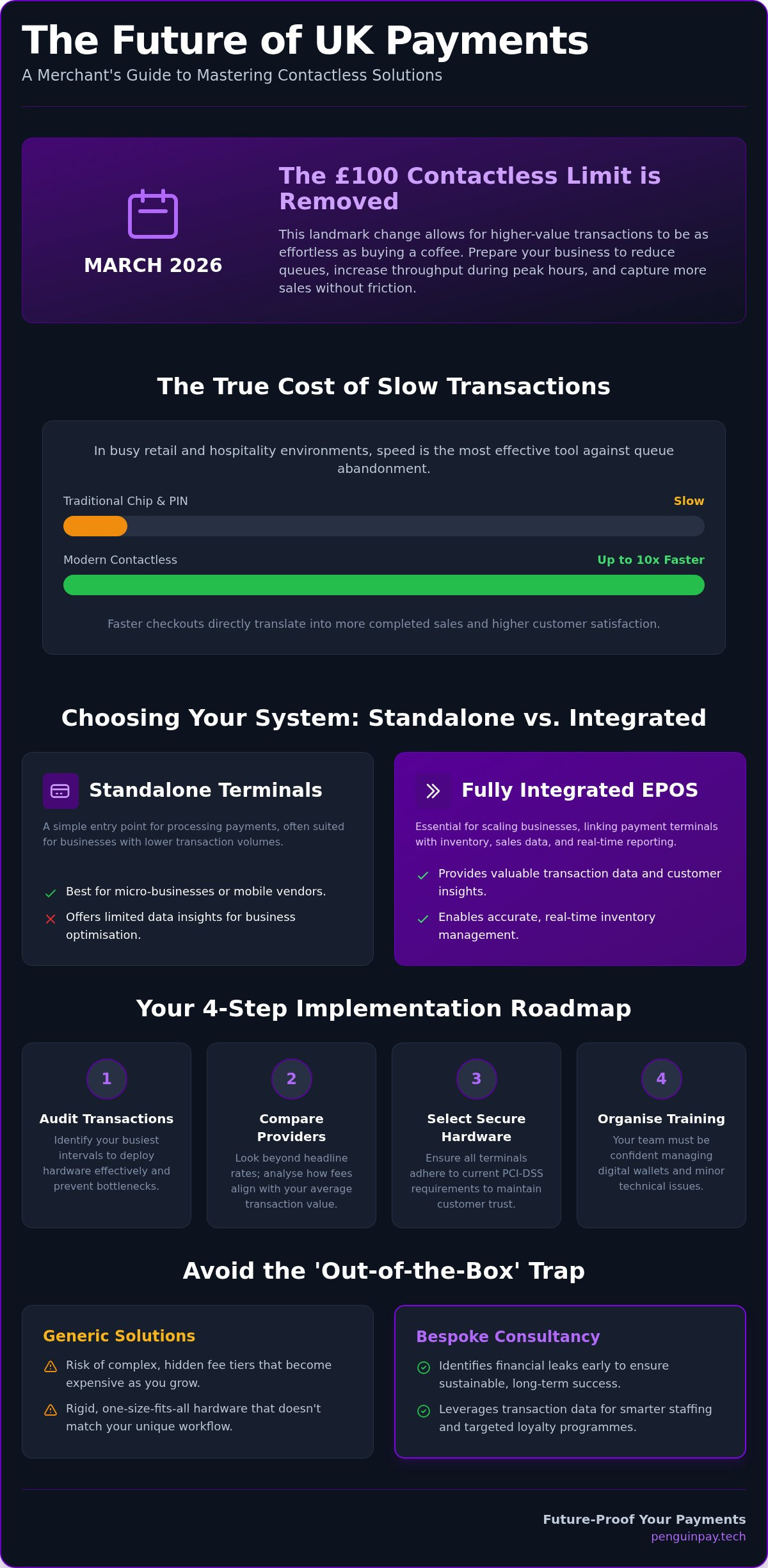
The commercial case for adopting these systems centres on operational efficiency. In busy hospitality and retail environments, speed is the most effective tool against queue abandonment. Industry data indicates that contactless transactions can be up to 10 times faster than traditional chip-and-pin methods. This efficiency ensures that high footfall during peak hours translates into completed sales rather than frustrated customers leaving the premises.
Choosing Between Standalone Terminals and Integrated Systems
Selecting the right hardware requires a clear understanding of your operational scale. Standalone card readers are often suitable for micro-businesses with lower transaction volumes; they provide a simple entry point but offer limited data insights. However, for businesses looking to scale, linking your payment terminals to Fully Integrated EPOS systems is essential for accurate inventory management and real-time reporting. This connection ensures that every tap at the terminal updates your stock levels instantly.
Many UK retailers now favour a hybrid approach. This involves utilising mobile card machines for personalised service on the shop floor or at the table, whilst maintaining a central hub for stock control. This flexibility ensures you never miss a sale due to a static till point. By choosing a solution tailored to your specific workflow, you create a seamless experience that builds long-term customer loyalty and avoids the rigid, high-fee structures of generic providers.
How to Implement Contactless Payments: A Step-by-Step Guide
Implementing robust contactless payment solutions for business involves more than just plugging in a card machine. Success requires a logical, four-step strategy to ensure your investment delivers immediate returns in service speed and customer satisfaction.
- Step 1: Begin with a detailed audit of your transaction history. Identifying your busiest intervals allows you to deploy enough hardware to prevent bottlenecks during peak trading hours.
- Step 2: Finding the right contactless payment solutions for business involves comparing merchant providers with precision. Look beyond the headline rates and focus on how fees align with your average transaction value.
- Step 3: Select hardware that adheres to current PCI-DSS requirements. Security is the cornerstone of customer trust; you shouldn’t settle for outdated protocols.
- Step 4: Organise professional installation and comprehensive staff training. Your team should be adept at managing various digital wallets and resolving minor technical hitches instantly.
Assessing Your Business Infrastructure and Network Reliability
Your payment gateway’s performance depends entirely on your network’s stability. Check your shop’s Wi-Fi and 4G signal strength to ensure consistent connectivity during peak hours. Additionally, evaluate your floor layout; terminals should be positioned to guide customers naturally through the space without creating congestion. It is often beneficial to ensure your business banking for hospitality is fully compatible with your chosen hardware. If you require a tailored review of your current setup, you can request a professional consultation with our specialists.
Optimising Your Payment Strategy for Long-Term Growth
Many operators fall into the “out-of-the-box” trap by selecting generic contactless payment solutions for business that fail to account for specific operational nuances. These pre-packaged deals often hide complex fee tiers that become increasingly expensive as your volume increases. A bespoke consultancy approach identifies these financial leaks early, ensuring your contactless payment solutions for business remain sustainable as your turnover grows. By leveraging the transaction data from your integrated systems, you can pinpoint specific customer behaviours and favourite peak hours with precision. This insight allows for smarter staffing decisions and targeted loyalty programmes.
Preparation for the next generation of commerce is equally vital for those looking to lead their sector. Future-proofing your checkout involves readying your infrastructure for biometric authentication and emerging digital currencies that are set to redefine the high street. Drawing on Chris Niblett’s 28 years of IT experience, we help businesses navigate these technical shifts whilst avoiding the common implementation pitfalls that stall growth.
The Advantage of Independent Card Terminal Consultancy
An independent advisor serves as your advocate amongst various payment providers, negotiating bespoke rates that a single merchant could rarely secure alone. Our partner spotlight approach ensures you work with specialists who understand the unique economic pressures of the London and Midlands markets. Whether you’re managing a single unit in Chesterfield or a multi-site hospitality operation in London, your payment strategy must scale without friction. We ensure your system remains agile and transparent, focusing on your long-term commercial health.
Securing Your Commercial Future with Precision
Adopting modern contactless payment solutions for business is no longer merely an operational upgrade; it’s a strategic necessity for maintaining a competitive edge on the UK high street. By prioritising transaction speed and integrating your hardware with sophisticated EPOS systems, you can eliminate friction and capture vital customer data. Navigating the complexities of merchant fees and technical integration requires a partner who understands the unique pressures of the hospitality and retail sectors.
With over 28 years of IT and pre-sales experience, Chris Niblett provides the calm expertise needed to deploy bespoke solutions across London and the Midlands. We’re dedicated to acting as your advocate, ensuring your payment infrastructure is as resilient as your business ambitions. To ensure your setup is optimised for 2026 and beyond, book a bespoke payment consultation with PenguinPay today. Your journey toward a more efficient, profitable checkout begins with a single conversation.
Frequently Asked Questions
How much do contactless payment solutions for business typically cost in 2026?
Costs for contactless payment solutions for business are determined by your transaction volume and specific hardware needs. Rather than accepting standard market rates, we help you identify a fee structure that suits your average transaction value. This consultative method allows merchants in the Midlands and London to avoid the hidden charges often found in generic, non-bespoke service contracts.
Is it secure to accept contactless payments for high-value transactions?
Accepting contactless payments is highly secure due to advanced tokenisation and real-time fraud monitoring. Since the FCA removed the £100 limit in March 2026, banks have implemented sophisticated risk assessments for high-value taps. Each transaction uses a unique, one-time code, meaning your business never stores or transmits actual card numbers, ensuring total peace of mind for your customers.
Can I use a contactless card machine without a fixed landline or internet connection?
You don’t need a fixed landline to implement modern contactless payment solutions for business in your shop or restaurant. Most current terminals utilise 4G, 5G, or Wi-Fi connectivity to facilitate payments anywhere on your premises. This flexibility is perfect for boutique retailers in Leicester or London restaurants that want to reduce queue times by offering mobile, face-to-face card payments.
How long does it take to switch from a traditional card reader to a fully integrated system?
The time required to switch to Fully Integrated EPOS systems depends on your existing data and infrastructure complexity. Whilst hardware can often be delivered quickly, a thorough integration involves auditing and staff training to guarantee efficiency. Our structured approach ensures your business in Derbyshire or Staffordshire experiences a seamless transition with minimal disruption to your daily operations.