

Article by
Chris Niblett
With over 28 years of experience in IT and pre-sales roles, my transition into the hospitality and retail sectors has enabled me to help businesses of all sizes optimise their electronic payments and EPOS systems. My passion for service-driven solutions led me to create PenguinPay, where I provide tailored solutions that drive business success.
What if your payment setup worked around the way your ecommerce business operates, rather than making your team adapt to a generic process? Bespoke ecommerce payment integration starts with the connection between checkout, payment acceptance, order handling and finance workflows. When these steps sit apart, it can be hard to see where information is lost, who needs to act next and what the payment setup should improve.
This guide explains how to assess a tailored payment setup in a UK business context. You’ll find practical steps for mapping your current process, defining integration scope and responsibilities, and setting outcomes you can assess. PenguinPay’s consultative approach draws on founder Chris Niblett’s 28 years of IT and pre-sales experience to help businesses compare ecommerce gateway solutions against their operational needs.
Key Takeaways
- A bespoke ecommerce payment integration should fit how your business accepts payments and handles orders, rather than impose a generic workflow.
- Map the customer journey, payment information and staff handovers before setting the integration scope.
- Clarify responsibilities, implementation stages and intended outcomes so you can assess whether a proposed setup meets your needs.
- Compare ecommerce gateway solutions against your actual checkout and back-office requirements, not features in isolation.
Why bespoke ecommerce payment integration starts with the merchant’s workflow
A payment setup should support how your ecommerce business sells and manages orders, not force your team to reshape its processes around a generic checkout. Start by documenting the customer’s route to payment, what needs to happen after a transaction, and where staff need to access payment information.
Checkout, payment acceptance and back-office processes have different requirements. Customers need a clear way to pay, while your team may need payment records to handle orders or complete finance routines. Map each handover: note what information is created, who uses it next and where delays, duplicated work or missing details arise. This identifies the problem to solve before you compare gateways and avoids assuming every online business needs the same setup.
What makes an ecommerce payment integration bespoke?
“Bespoke ecommerce payment integration means tailoring payment services and integration decisions to a merchant’s operating requirements, not commissioning proprietary software.” A tailored approach can involve selecting suitable payment services and planning how they fit your business without building a new software product.
The useful question is how your ecommerce model and operational needs affect the payment decision. For example, if payment information is re-entered into another process, note where that happens and what your team needs to do with the information. That gives the discussion a specific focus without assuming one solution suits every business. PenguinPay provides bespoke payment consultancy and ecommerce gateways, with founder Chris Niblett bringing over 28 years of IT and pre-sales experience to these decisions.
For a grounding in how an e-commerce payment system works, consider the customer payment journey alongside the business processes it supports. Record where payment information is created, who uses it next and what currently makes the handover difficult. These details help keep a tailored discussion practical.
How the case shaped a practical UK ecommerce payment setup
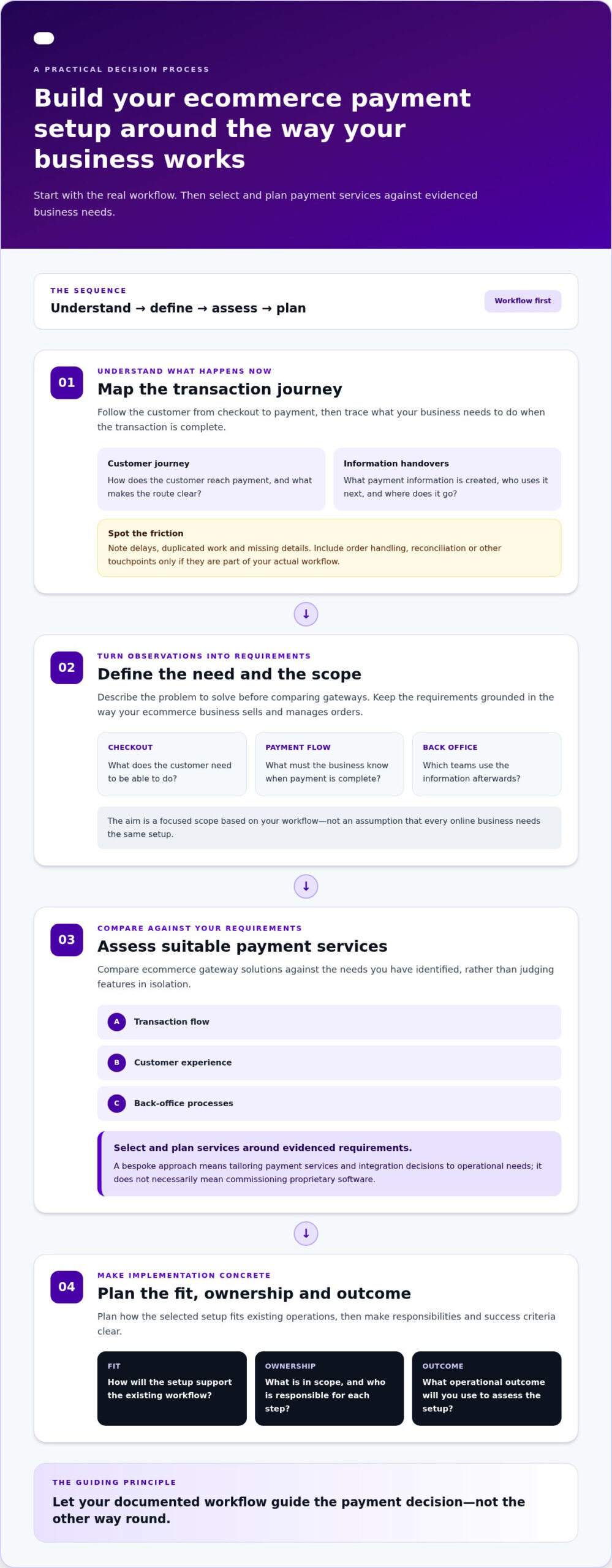
A sound integration decision follows a clear sequence: establish your requirements, assess suitable payment services, plan how the selected setup fits existing operations, then define implementation responsibilities. Tie each decision to a business need instead of assuming a particular platform, provider or payment method will suit every merchant.
Begin with the transaction journey. How does a customer reach payment? What does your business need to know when a transaction is complete? Which teams use that information afterwards? Include order handling, reconciliation or other touchpoints only where they are part of your actual workflow. This keeps the scope focused and gives you a practical basis for judging whether a proposed setup fits.
Which decisions make an integration fit the business?
Choosing a payment provider is one part of the wider process. Compare ecommerce gateway solutions against your requirements for transaction flow, customer experience and back-office processes. This is more useful than comparing features in isolation. The Bank of England’s role in UK payments offers wider context on payment infrastructure, but your gateway decision should reflect your own business needs.
The key integration decision is to select and plan payment services around your evidenced requirements, rather than assume a custom-built platform is necessary. This is the practical distinction at the heart of bespoke ecommerce payment integration. It also makes implementation planning more concrete: agree what is in scope, who is responsible for each step, and what operational outcome you will use to assess the setup.
PenguinPay’s bespoke payment consultancy helps connect operational requirements with suitable payment and EPOS solutions. A conversation about your ecommerce payment requirements is a practical next step.
What the ecommerce payment case shows about choosing a next step
A useful case study should show how payment decisions relate to day-to-day operations, not promise results that may not apply to your business. Before choosing a setup, define what it needs to support: a clear customer payment journey, workable handovers to the relevant teams and payment information that serves your finance processes. These are practical criteria you can use to compare options.
What should a business clarify before discussing integration?
Prepare a concise picture of your current setup. Record:
- the steps a customer follows from checkout to payment confirmation;
- the ecommerce platform and payment services involved;
- how your team uses order and payment information after a transaction;
- the specific delays, duplicated tasks or information gaps your team encounters;
- what you want the revised process to make clearer or easier to manage.
This gives a consultancy discussion a defined starting point. PenguinPay relates those requirements to suitable payment choices and ecommerce gateway solutions, rather than assuming one configuration fits every merchant. You can then assess a bespoke ecommerce payment integration against the workflow it needs to support, with scope and responsibilities clear before implementation planning advances.
Gateway assessment should also distinguish your operational needs from the obligations of payment institutions. The FCA explains its regulatory framework for electronic money and payment institutions in its guidance on FCA regulations for payment institutions. This is useful UK context, but it does not replace defining your own integration requirements.
Whether your business is in London or Greater London, Nottingham, Leicester, Chesterfield, Derby, Lincoln or Grantham, or elsewhere in Derbyshire, Nottinghamshire, Leicestershire, Lincolnshire, Staffordshire or the Midlands, documenting your checkout journey and pain points gives a focused discussion a practical starting point. Discuss your ecommerce payment requirements with PenguinPay.
Make your next payment decision with clarity
You don’t need a detailed technical specification to begin. Identify the operational change that matters most, then use it to guide a discussion about payment options, responsibilities and the outcome you need. For example, you might want payment information to be easier to use in order handling or finance routines. A clearly stated need gives your team a practical way to assess a bespoke ecommerce payment integration before committing to changes.
PenguinPay is a UK-based, service-driven payment consultancy founded by Chris Niblett, who brings over 28 years of IT and pre-sales experience. The consultancy helps connect business requirements with considered payment choices, so the proposed approach has a clear purpose within your operations.
When you’re ready to explore the requirements behind your setup, start a conversation about your ecommerce payment setup with PenguinPay.
Frequently Asked Questions
Does bespoke ecommerce payment integration mean building a new online shop?
No. Bespoke ecommerce payment integration adapts payment services and related workflows to business requirements. It doesn’t inherently mean rebuilding the online shop. A retailer, for example, might keep its existing storefront while reviewing how payment acceptance fits checkout and order handling. Payment consultancy helps assess these choices; it is distinct from commissioning proprietary software.
How long does ecommerce payment integration take?
There isn’t a reliable standard duration. Timing depends on the requirements, systems involved and agreed scope. Project boundaries need to be clear before a useful estimate can be made. Identify who owns decisions, what information or access is needed, and how the setup will be tested before it goes live. Mapping your current checkout and business processes helps turn these points into a practical plan.
Can an ecommerce payment integration connect with an existing EPOS system?
It may be possible, depending on the systems and integration requirements. An assessment can establish whether online payment records need to appear in the EPOS workflow, support order handling or be reviewed separately. The EPOS platform and your requirements will shape the approach, so don’t assume a specific connection in advance. PenguinPay considers payment and EPOS needs together to help identify a suitable solution.
What information should a business prepare for an ecommerce payment consultation?
Prepare the name of your ecommerce platform, a simple description of how customers pay, the systems your team uses afterwards and the points that cause extra work. Whether your business is in London or Greater London, Nottingham, Leicester, Chesterfield, Derby, Lincoln or Grantham, or elsewhere in Derbyshire, Nottinghamshire, Leicestershire, Lincolnshire, Staffordshire or the Midlands, this information gives a consultancy discussion a practical starting point. Also state what you want a useful result to change.