

Article by
Chris Niblett
With over 28 years of experience in IT and pre-sales roles, my transition into the hospitality and retail sectors has enabled me to help businesses of all sizes optimise their electronic payments and EPOS systems. My passion for service-driven solutions led me to create PenguinPay, where I provide tailored solutions that drive business success.
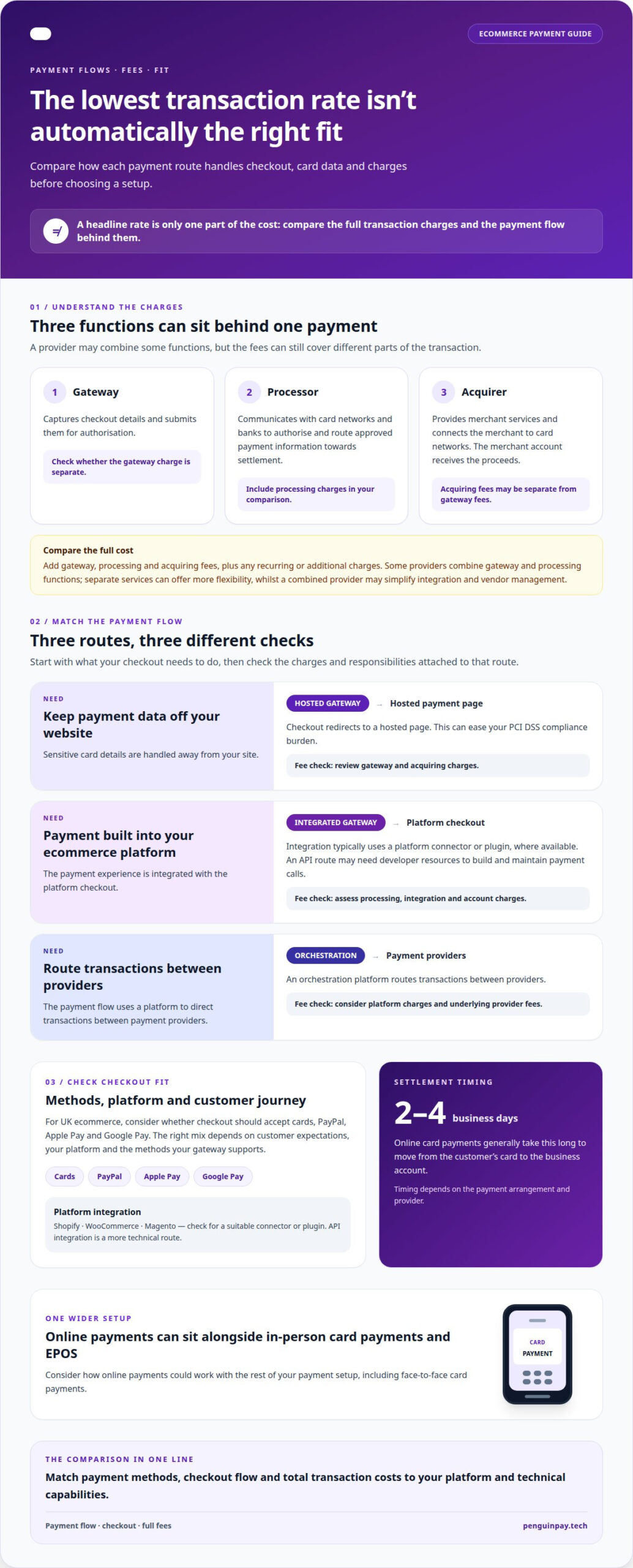
The lowest transaction rate does not automatically make a payment setup the right fit. When choosing ecommerce payment gateway solutions, distinguish the gateway, which captures payment details and submits them for authorisation, from the processor, which communicates with card networks and banks to authorise and settle transactions. Some providers combine both functions.
It is understandable to focus on fees first, but the payment flow, checkout experience and security responsibilities also shape the decision. A hosted gateway, for example, handles sensitive payment data away from your website, which can ease your PCI DSS compliance burden.
This guide explains how gateway and processor fees work, what to consider about PCI DSS, and how different payment flows suit different types of UK businesses. You will also find a practical comparison to help narrow your options, whether you run a small online shop, a growing retail operation or an ecommerce business with more complex requirements.
Key Takeaways
- Break down each payment charge by function so you can compare fee structures on a like-for-like basis.
- Understand how checkout design affects the handling of card data and your PCI DSS responsibilities.
- Match the payment flow to your business model, from a straightforward online shop to a more complex operation.
- Consider how online payments could work alongside in-person card payments and EPOS in your wider setup.
How do payment gateways impact transaction fees?
For an online card transaction, the gateway captures checkout details and sends them for authorisation. The processor communicates with card networks and banks, then routes approved payment information towards settlement. An acquirer provides merchant services and connects the merchant to card networks; the merchant account receives the proceeds. Some providers combine gateway and processing functions, while payment gateway fees can be separate from acquiring fees.
Costs depend on the payment flow and the provider’s pricing model. Compare the full transaction charges, including gateway, processing and acquiring fees, alongside any recurring or additional charges. A combined provider may simplify integration and vendor management; separate services can give a merchant more flexibility. Stripe is one example of a named provider, but compare its arrangement with your requirements rather than assuming all providers work alike.
For UK ecommerce, consider whether checkout should accept cards, PayPal, Apple Pay and Google Pay. The right mix depends on customer expectations, your ecommerce platform and the payment methods the gateway supports.
For Shopify, WooCommerce or Magento, integration typically uses a platform connector or plugin, where available. An API integration offers a more technical route and may require developer resources to build and maintain payment calls.
Online card payments generally take two to four business days to move from the customer’s card to the business account. Settlement timing depends on the payment arrangement and provider.
| Option | Payment flow | Fee consideration |
|---|---|---|
| Hosted gateway | Checkout redirects to a hosted payment page. | Review gateway and acquiring charges. |
| Integrated gateway | Payment is built into the ecommerce platform. | Assess processing, integration and account charges. |
| Orchestration platform | Routes transactions between payment providers. | Consider platform charges and underlying provider fees. |
Choose a solution by matching payment methods, checkout flow and total transaction costs to your platform and technical capabilities.
How can merchants ensure PCI DSS compliance when using on-site payment gateways?
For refunds and recurring payments, compare whether staff can issue refunds, manage renewals and reach support through clear channels. Chargebacks can trigger fees or account holds; an acquirer may consider ending its relationship with a merchant if the chargeback percentage exceeds 1%.
PCI DSS and card-data security
PCI DSS sets requirements for protecting card data; UK businesses handling card payments must comply. An on-site checkout captures card details on the merchant’s site, unlike a hosted page, where payment data is handled off-site and the compliance burden can be eased. PCI levels depend on annual card volume: Level 4 covers fewer than 20,000 transactions, Level 3 covers 20,000-1 million, Level 2 covers 1-6 million, and Level 1 covers over 6 million.
Encryption and fraud prevention
At checkout, encryption methods such as SSL protect customer information in transit; fraud-protection systems help identify unauthorised transactions. These controls differ from PCI DSS: encryption protects data as it moves, while compliance covers the wider card-data environment. For Strong Customer Authentication considerations, 3DS is a security protocol that authenticates users in card-not-present transactions.
Tokenisation and 3D Secure
Tokenisation replaces a card number with a secure token, limiting exposure of the original details during later payments. Card vaulting stores payment credentials for uses such as recurring billing, so access controls around stored data matter. Unlike encryption, which protects information in transit, tokenisation reduces reliance on the live card number; 3DS adds an identity check during an online transaction.
For an online checkout, discuss gateway configuration to align payment data flows with your support needs.
Payment gateway examples by business type
There is no single best ecommerce gateway for every UK merchant. The right ecommerce payment gateway solutions depend on your platform, payment methods, merchant account arrangement and plans for international sales.
For a small shop using Shopify or WooCommerce, start by assessing gateways that integrate with its checkout. Stripe and PayPal are examples to consider for platform fit and the payment methods customers expect. A compatible integration can keep setup straightforward; a checkout flow that does not suit the platform may require additional technical work.
A growing retailer should assess how online payments fit into its wider commerce operation. Compare how providers handle card and debit card payments, refunds, recurring transactions and reporting. Worldpay and Checkout.com are also examples to consider. What matters is how each option fits your requirements, not whether one name is universally best.
For international sales, examine support for the currencies and payment methods relevant to your target markets. A UK-only merchant may prioritise a familiar checkout and platform integration. A business selling across countries may place more weight on currency handling and transaction routing. Since the checkout journey can influence conversion, consider the customer experience alongside payment acceptance.
Stripe, PayPal, Worldpay and Checkout.com differ in platform compatibility, payment methods, international capabilities, account arrangements and technical integration. Assess any proposed charge in context, including the transaction flow and the services it covers. These criteria can help you narrow ecommerce payment gateway solutions to suit your business model.
List your sales channels, target currencies and required payment methods, then match them to the proposed integration. Discuss your ecommerce gateway requirements to identify a suitable setup for your business.
Stripe, PayPal, Worldpay and Checkout.com are examples to consider, but the right choice depends on your platform, payment methods, account setup and international sales needs. Compare how each fits your checkout and business requirements rather than treating one as universally best.
PenguinPay: Face-to-Face Card Payments
PenguinPay helps businesses consider how in-person card payments fit alongside their online payment setup. If customers can buy through both a website and a physical location, aligning payment arrangements across sales channels can make operations easier to manage.
For example, a retailer selling online and in a shop may need E-commerce gateways for website transactions and Face-to-Face Card Payments at the till. A Fully Integrated EPOS system can also support joined-up in-person sales operations. The right combination depends on how your business takes payments and manages day-to-day sales.
PenguinPay can discuss these options with businesses reviewing their payment flow or planning to bring online and in-person payments together. Contact PenguinPay to discuss your business’s payment requirements.
Plan your next stage of payment growth
As your sales channels evolve, treat payment choices as part of a wider operating plan, not simply a checkout setting. Map how customers move between online and in-person purchases, then consider how payment activity fits into everyday business decisions. This can help you assess ecommerce payment gateway solutions against your growth plans, rather than choosing based on one feature alone.
PenguinPay offers E-commerce gateways, Face-to-Face Card Payments, Fully Integrated EPOS systems and Business Banking. These options are relevant if you are reviewing how online payments relate to in-person transactions and broader banking needs. A useful next step is to discuss the priorities that matter to your operation, including the sales channels and payment flow you want to support.
Contact PenguinPay to discuss your payment requirements. A considered setup can give your business a clearer foundation for its next stage.
Frequently Asked Questions
Payment gateway vs payment processor: what is the difference?
A gateway handles the checkout connection, while a processor carries payment information through the card-payment system. For example, an online shop may use a gateway to collect a customer’s card details, then rely on processing services to request authorisation. The merchant account receives payment proceeds. One provider can combine these functions, so the names do not always indicate separate services.
What are ecommerce payment solutions and how do they work?
Ecommerce payment solutions are the services and tools that let a business accept payments through its online shop. A typical setup connects the shop’s platform to a gateway and processing arrangement, with a merchant account for receiving proceeds. The right combination depends on the platform, checkout design and payment methods the business wants to offer, such as cards or digital wallets.
How does an online payment gateway work?
At checkout, the customer enters payment details or selects a digital wallet. The gateway securely sends the transaction for authorisation and returns an approval or decline message to the shop. If approved, the order can proceed; funds are settled to the business account later. For example, a shop can use the payment response to show a confirmation page or prompt the customer to try another method.
Can I get a payment gateway for my high-risk business?
A high-risk business may need to use a gateway determined by its acquirer, which assesses the merchant’s payment arrangement. This can limit the available payment flow compared with a low-risk business, which may use a gateway that supports multiple acquirers. Before choosing an integration, establish which acquiring arrangement applies and whether the gateway supports your business model and transaction pattern.
Can payment gateways handle international payments?
Yes, a gateway can support international payments when its setup accommodates the customer’s payment method and the currencies relevant to the sale. For example, a UK retailer selling to overseas customers should consider which currencies it wants to accept and how those options appear at checkout. Also assess whether the gateway and acquiring arrangement support the markets your business plans to serve.