

Article by
Chris Niblett
With over 28 years of experience in IT and pre-sales roles, my transition into the hospitality and retail sectors has enabled me to help businesses of all sizes optimise their electronic payments and EPOS systems. My passion for service-driven solutions led me to create PenguinPay, where I provide tailored solutions that drive business success.
What happens after a customer taps a card or pays online? The approval message is just one moment in a wider payment processing journey. Knowing who handles each step can help you understand when funds reach your business and compare providers more confidently. A payment involves several organisations working together behind the scenes, and their responsibilities can vary between arrangements.
This guide follows a payment from the customer to your business, from authorisation through to settlement. You’ll learn the roles of the merchant, processor, acquirer and card issuer, and find practical questions to ask when reviewing your setup. You’ll also see how to assess payments for in-person, online and multi-channel sales, so you can compare options against the way your business actually operates.
Key Takeaways
- Payment processing involves more than accepting a card. Understanding each stage helps you identify how a transaction is handled and when funds reach your business.
- Processors, acquirers, card schemes and issuing banks have distinct roles, although a provider may combine some services.
- Assess face-to-face, eCommerce and integrated EPOS requirements against how you sell. One setup may not suit every channel.
- Before choosing an arrangement, ask about reporting, integrations, accepted payment methods, support and how fees are structured.
Payment processing explained: what happens when a customer pays?
Payment processing is the handling and transfer of payment information between a customer, a business and the organisations that assess and complete a transaction. Accepting a card is the customer-facing action. Processing is the journey behind the scenes: payment information is sent for a decision and, if approved, the transaction can proceed towards settlement.
A typical card transaction involves the customer, who initiates payment; the merchant, the business selling goods or services; the payment method, such as a physical card or digital wallet; and the processing services that help route the information. A payment processor can transmit transaction data between the merchant, acquirer and card issuer. Provider arrangements vary, and one organisation may perform more than one role.
What does payment processing mean for a UK business?
It means payment information is transmitted through the relevant services so the transaction can be assessed. For a card payment, an authorisation request asks whether the payment can be approved. The issuer responds, but approval is not the same as settlement. The later movement of funds to the merchant is a separate stage.
For example, when a customer taps a card to pay for lunch, the till or card terminal captures the payment request and sends it through the business’s payment arrangements. The customer receives an approval or decline, while settlement follows through the providers involved. An online card purchase may take a related route, although other payment methods can work differently. Knowing the difference between authorisation and settlement helps you ask who handles each stage and how your chosen setup fits your business.
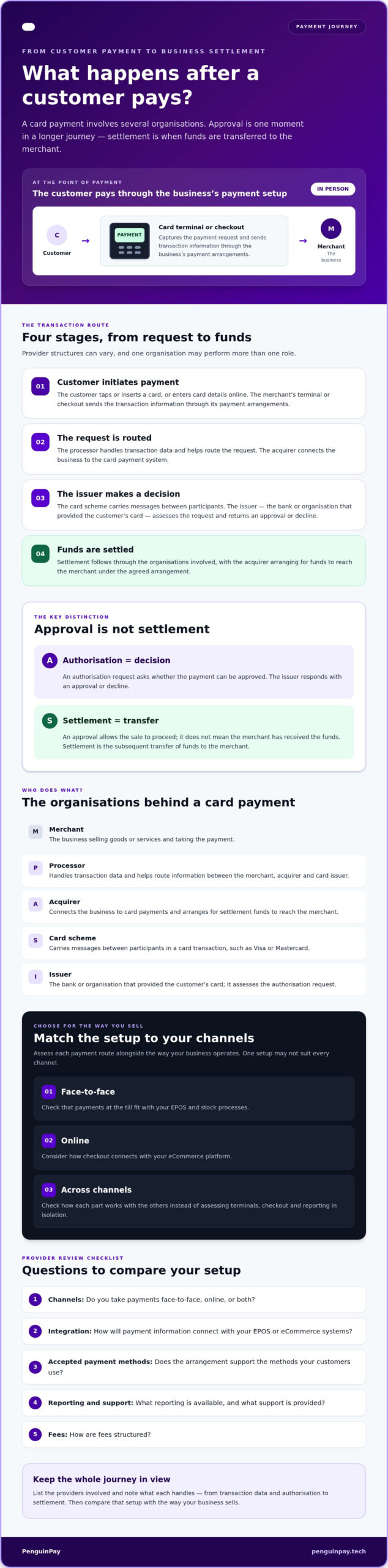
How payment processing works: follow the authorisation and settlement journey
A card payment passes through several connected stages. The exact provider structure can vary, but the distinction between approval and the later movement of funds remains useful: authorisation is the decision on a payment request; settlement is the subsequent transfer of funds to the merchant.
- Customer initiates payment. A customer taps or inserts a card, or enters card details online. The merchant’s terminal or checkout sends the transaction information through its payment arrangements.
- Request is routed. A processor handles transaction data and helps route the request. The acquirer, often called the acquiring bank, provides the merchant’s connection to the card payment system. These roles may be provided separately or combined.
- Issuer makes a decision. The card scheme, such as Visa or Mastercard, carries messages between participants in a card transaction. The issuer, the bank or organisation that provided the customer’s card, assesses the authorisation request and returns an approval or decline through the route to the merchant’s payment channel.
- Funds are settled. An approval allows the sale to proceed, but it doesn’t mean the merchant has received the funds. Settlement follows through the organisations involved, with the acquirer arranging for funds to reach the merchant under the agreed arrangement.
Who handles a card payment between the customer and the merchant?
In short, the merchant takes the payment, the processor handles transaction data, the acquirer connects the business to card payments, the scheme carries messages, and the issuer decides whether to authorise. Not every provider uses the same structure, and other payment methods may follow different routes. For UK context on payment systems, see the Payment Systems Regulator (PSR).
To make this useful when reviewing your own setup, list the providers involved and note what each one handles, from transaction data to settlement. If you’d like to review how your payment setup fits your operations, you can discuss your payment arrangements.
Choosing payment processing for your business: match the setup to how you sell
The right arrangement depends on your sales channels and day-to-day workflow, not simply the number of payment methods available. A retailer may need payments at the till to fit with its EPOS and stock processes. A hospitality business may prioritise a setup that fits its service flow, while an online seller may focus on how checkout connects with its eCommerce platform. If you sell across channels, check how each part works with the others rather than assessing terminals, checkout and reporting in isolation.
What should a business check before reviewing payment providers?
Use these questions to compare arrangements against your actual operations:
- Channels: Do you take payments face-to-face, online, or both? Check that the setup supports the way customers pay in each channel.
- Integration: How will payment information connect with your EPOS or eCommerce systems? Confirm which provider handles each connection and what may need to change if you replace a system.
- Reporting: Can you review transactions across channels in a way that supports your reconciliation and record-keeping processes? Check what information is available and whether it is easy to match payments to sales.
- Payment methods: Which methods can the arrangement accept? Consider whether they suit your customers and the way you take payments.
- Support and fees: What support is available, how can you contact the provider, and how are charges structured? Ask for a clear explanation of transaction, service and other fees rather than assuming one pricing model applies to every business.
For further reading, explore guidance on payment solution providers. PenguinPay provides consultative guidance on bespoke EPOS and payment solutions for hospitality, retail and eCommerce businesses. Its approach is to match the arrangement to operational needs, whether you’re reviewing face-to-face payments, an eCommerce gateway or an integrated EPOS setup. Businesses in London, Greater London, Nottingham, Leicester, Chesterfield, Derby, Lincoln and Grantham, as well as Derbyshire, Nottinghamshire, Leicestershire, Lincolnshire, Staffordshire and the wider Midlands, can use these questions to prepare for a review.
Make your payment setup work for your business
Understanding payment processing gives you a clearer basis for reviewing how transactions are handled, who takes part and how funds reach your business. Start by distinguishing authorisation from settlement, then check whether the arrangement supports the way you sell, whether face-to-face, online or across multiple channels.
There’s no single setup that suits every operation. Consider how payments fit your systems, reporting and daily workflow before comparing providers. PenguinPay offers consultative guidance on payment and EPOS solutions for hospitality, retail and eCommerce businesses. The consultancy was founded by Chris Niblett, whose experience spans over 28 years in IT and pre-sales.
If you’re ready to explore an arrangement suited to your business, discuss a payment setup suited to your business with PenguinPay.
Frequently Asked Questions
What is payment processing?
Payment processing is the series of steps that enables a business to accept and manage a customer’s payment. It typically involves sending payment details for authorisation, returning an approval or decline, and arranging settlement. The organisations involved and the route taken can vary according to the payment method, provider and business setup.
How does payment processing work step by step?
A customer starts a payment at a card terminal, online checkout or another supported channel. The request passes through the relevant payment services for authorisation, and the response returns to the merchant. If approved, the transaction can proceed to settlement, when funds are transferred under the arrangements between the parties. The exact route depends on the payment method and provider setup.
What is the difference between a payment processor and an acquirer?
A payment processor handles the technical transmission of payment information between the parties involved in a transaction. An acquirer provides the merchant-facing acquiring service that enables a business to accept card payments. Some providers combine these roles or offer several related services, so check what each organisation is responsible for and review the terms of your specific arrangement.
Is payment processing secure for a small business?
Payment security depends on the systems, providers and operating practices involved, so don’t assume a setup is secure without checking its requirements. Ask how payment data is handled, what responsibilities apply to your business and which standards are relevant. Consult the article’s PCI-compliance guide and verify current requirements before making changes. PenguinPay advises businesses in London, Greater London, Nottingham, Leicester, Chesterfield, Derby, Lincoln, Grantham, Derbyshire, Nottinghamshire, Leicestershire, Lincolnshire, Staffordshire and the Midlands.