

Article by
Chris Niblett
With over 28 years of experience in IT and pre-sales roles, my transition into the hospitality and retail sectors has enabled me to help businesses of all sizes optimise their electronic payments and EPOS systems. My passion for service-driven solutions led me to create PenguinPay, where I provide tailored solutions that drive business success.
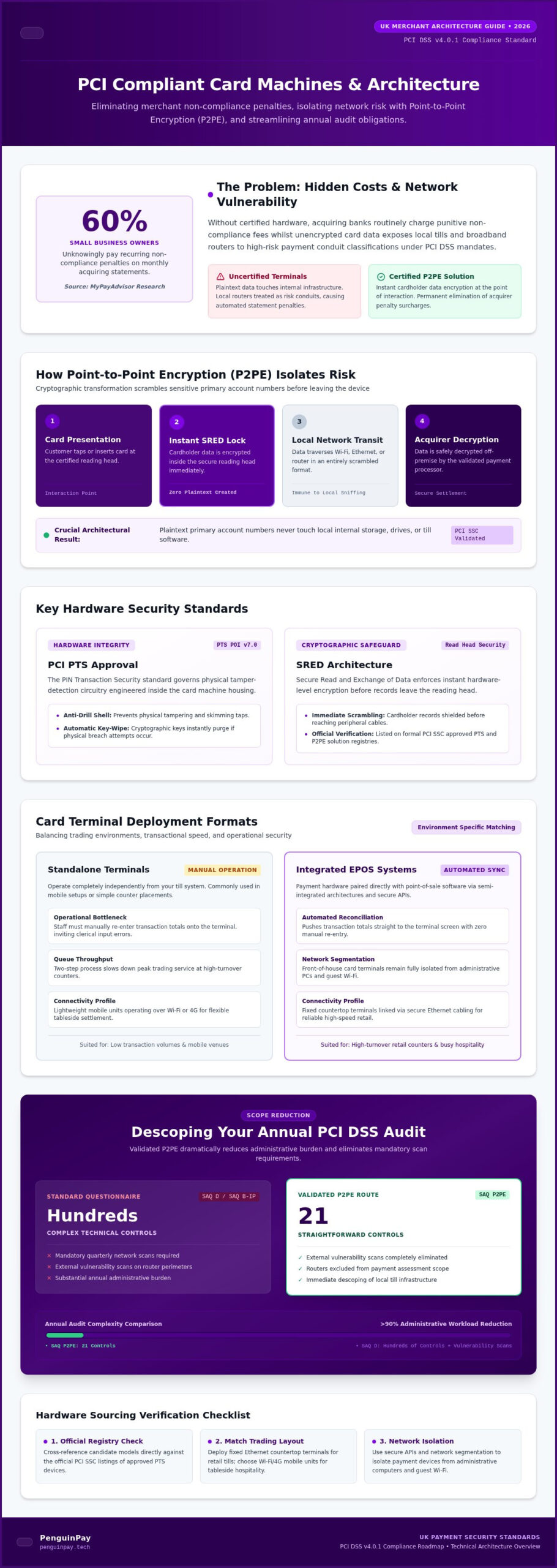
According to research from MyPayAdvisor, roughly 60% of small business owners unknowingly pay recurring non-compliance penalties on their acquiring statements. When you’re managing daily trade, trying to decode the technical mandates of PCI DSS v4.0.1 shouldn’t consume your valuable time. Deploying certified PCI compliant card machines UK businesses can rely on provides a dependable, stress-free way to regain control.
You probably agree that confusing compliance portals, dense technical jargon, and anxieties over payment security create unnecessary operational friction. By reading on, you’ll discover how certified card machines protect your UK business, simplify compliance assessments, and eliminate unwanted acquirer fees. Here is your practical roadmap to securing your payment infrastructure and protecting your hard-earned revenue in 2026.
Key Takeaways
- Learn how certified PCI compliant card machines UK businesses deploy use point-to-point encryption to isolate sensitive data from local till networks.
- Discover whether standalone mobile units or fully integrated EPOS systems provide the best balance of transactional speed and operational security for your trading environment.
- Understand how validated security hardware shrinks your annual compliance audit from hundreds of complex technical controls down to a simple, streamlined assessment.
- Identify practical methods to permanently remove recurring processor non-compliance penalties from your monthly merchant statements.
Understanding PCI Compliant Card Machines: UK Security Standards Explained
Operating secure card terminals involves far more than simply accepting contactless taps. Formally, PCI compliant card machines UK retailers and restaurateurs deploy must satisfy rigorous hardware benchmarks established by the PCI Security Standards Council (PCI SSC). The primary technical safeguard governing these devices is Point-to-Point Encryption (P2PE).
When a customer presents a debit or credit card, a certified P2PE terminal instantly encrypts the primary account number at the exact moment of interaction. This cryptographic transformation ensures that sensitive data passes through your local Wi-Fi, Ethernet cabling, and broadband router entirely scrambled. Because plaintext data never touches your internal infrastructure, your business avoids treating standard local routers as high-risk payment conduits. Crucially, deploying legitimate hardware prevents the punitive non-compliance penalties that acquiring banks automatically add to monthly processing statements when security standards lapse.
Key Hardware Certifications: PCI PTS and SRED Standards
Reliable hardware relies on distinct technical layers to defeat modern physical and digital fraud attempts:
- PCI PTS Approval: The PIN Transaction Security standard mandates physical tamper-detection circuitry. If an intruder attempts to drill into the shell or install internal skimming taps, the device wipes its cryptographic keys immediately. Modern deployments follow stringent PTS POI v7.0 specifications.
- SRED Architecture: Secure Read and Exchange of Data ensures cardholder records are encrypted directly inside the secure reading head before transmitting across peripheral cables.
Before sourcing hardware, always cross-reference prospective models against the official PCI SSC listings of approved PTS devices and validated P2PE solutions. Independent consultative sourcing ensures your hardware natively protects client goodwill while keeping your network isolated from payment risk.
Selecting the Right PCI Compliant Card Terminal for Your Business
Every commercial setting demands a tailored approach to face-to-face card payments. High-turnover retail counters benefit from fixed countertop terminals connected via secure Ethernet, whilst bustling hospitality venues need lightweight mobile units operating over Wi-Fi or 4G for tableside settlement. Sourcing PCI compliant card machines UK merchants can rely on involves matching physical capabilities directly to your trading environment, ensuring staff never resort to improvised workarounds. Sourcing hardware through reputable payment providers allows you to evaluate certified devices designed specifically for your transaction volume and physical layout.
Standalone Terminals Versus Integrated EPOS Architectures
Standalone terminals function independently from your till, requiring staff to re-enter sale totals manually. This two-step process frequently invites clerical errors and slows down busy queues during peak trading hours. In contrast, pairing payment hardware with fully integrated EPOS systems automates daily reconciliation by pushing transaction amounts straight to the terminal screen.
Modern semi-integrated architectures achieve this operational harmony without expanding your compliance exposure. By using secure APIs, the point-of-sale till sends only transactional amounts, whilst the terminal processes card details directly with the acquirer. Sensitive account numbers never touch local till software or internal storage drives. Dedicated network segmentation isolates front-of-house payment terminals from administrative computers and guest Wi-Fi networks, preventing unauthorised access. If you’d like to streamline operations while keeping your cardholder environment secure, you can speak with an independent specialist to review your current payment infrastructure.
Descoping Annual PCI DSS Compliance and Eradicating Acquirer Fees
Selecting certified PCI compliant card machines UK businesses trust changes your annual regulatory obligations overnight. Without a validated Point-to-Point Encryption solution, trading venues must tackle extensive compliance questionnaires like SAQ D or SAQ B-IP, completing scores of complex technical questions alongside mandatory quarterly network scans. Validated P2PE hardware scrambles cardholder details directly inside the physical reader. This drastic reduction in scope condenses your annual compliance verification down to the streamlined SAQ P2PE of just 21 straightforward controls.
This architectural isolation completely eliminates the requirement for external vulnerability scans across your local routers and network perimeter. It lifts a heavy administrative weight off your shoulders. Because cardholder records never linger on local hardware or internal servers, your enterprise avoids catastrophic data breach liabilities. Crucially, acquiring banks have no contractual grounds to levy recurring non-compliance penalties against your merchant account once your attestation of compliance is properly submitted.
Partnering with Independent Payment Consultants for Seamless Implementation
Deciphering merchant acquiring statements requires seasoned commercial oversight. Established by Chris Niblett, PenguinPay brings over 28 years of IT and payment infrastructure consultancy to retail and hospitality businesses across London and the Midlands. Independent payment audits pinpoint unjustified compliance surcharges and outdated hardware leases, helping you select modern terminals that protect transaction margins. To evaluate secure, vetted terminal architectures tailored to your operational environment, explore our partner spotlight.
Future-Proof Your Point of Sale with Confidence
Protecting customer transactions shouldn’t involve endless compliance headaches or unexpected charges on your monthly statements. Selecting verified PCI compliant card machines UK businesses trust simplifies your annual attestations and stops data vulnerabilities right at the counter. When your hardware isolates sensitive cardholder details through validated encryption, operational peace of mind naturally follows.
Led by Chris Niblett with over 28 years of IT and consultative payment solutions experience, our independent guidance helps UK businesses streamline payment hardware and EPOS integration. You don’t have to navigate changing security standards alone. Speak with the team at PenguinPay to secure your payment terminals and eliminate non-compliance fees today, ensuring your trading environment stays resilient, efficient, and fully protected.
Frequently Asked Questions
Can using a certified P2PE card machine reduce my annual PCI DSS compliance workload?
Yes, adopting a validated P2PE card machine significantly reduces your compliance burden by isolating sensitive cardholder data from your local network. Because payment details are encrypted before reaching local switches or routers, your business qualifies for the shortest self-assessment questionnaire, SAQ P2PE. This removes the need for quarterly vulnerability scans, cutting annual administrative paperwork down to under an hour.
What happens if my UK business fails to validate PCI compliance with our merchant acquirer?
Failing to validate your compliance status typically results in your acquiring bank adding recurring monthly non-compliance fees directly onto your processing statement. Beyond recurring financial penalties, unvalidated businesses face heightened financial liability if a card security compromise occurs. Acquirers may also restrict transaction allowances or terminate merchant accounts, leaving trading venues across London and the Midlands unable to trade.
How does PCI DSS v4.0 impact card machines used in UK retail and hospitality?
Under the active PCI DSS v4.0.1 standard, all merchants using PCI compliant card machines UK wide must satisfy stricter technical requirements around access controls and physical device inspections. Business owners must maintain documented device asset registers, log regular physical checks against skimming overlays or swapped hardware, and enforce stronger authentication protocols. These updated standards ensure modern smart terminals remain insulated from external software risks.
Is a standalone card reader safer for a small shop than an integrated EPOS system?
Neither setup is inherently safer; security depends entirely on how the overall system isolates cardholder data. Standalone readers keep payments physically separate, but manual amount entry invites frequent reconciliation errors during busy shifts. Properly configured fully integrated EPOS systems paired with certified PCI compliant card machines UK shops deploy maintain strict network segmentation, delivering rapid speed and operational security together.