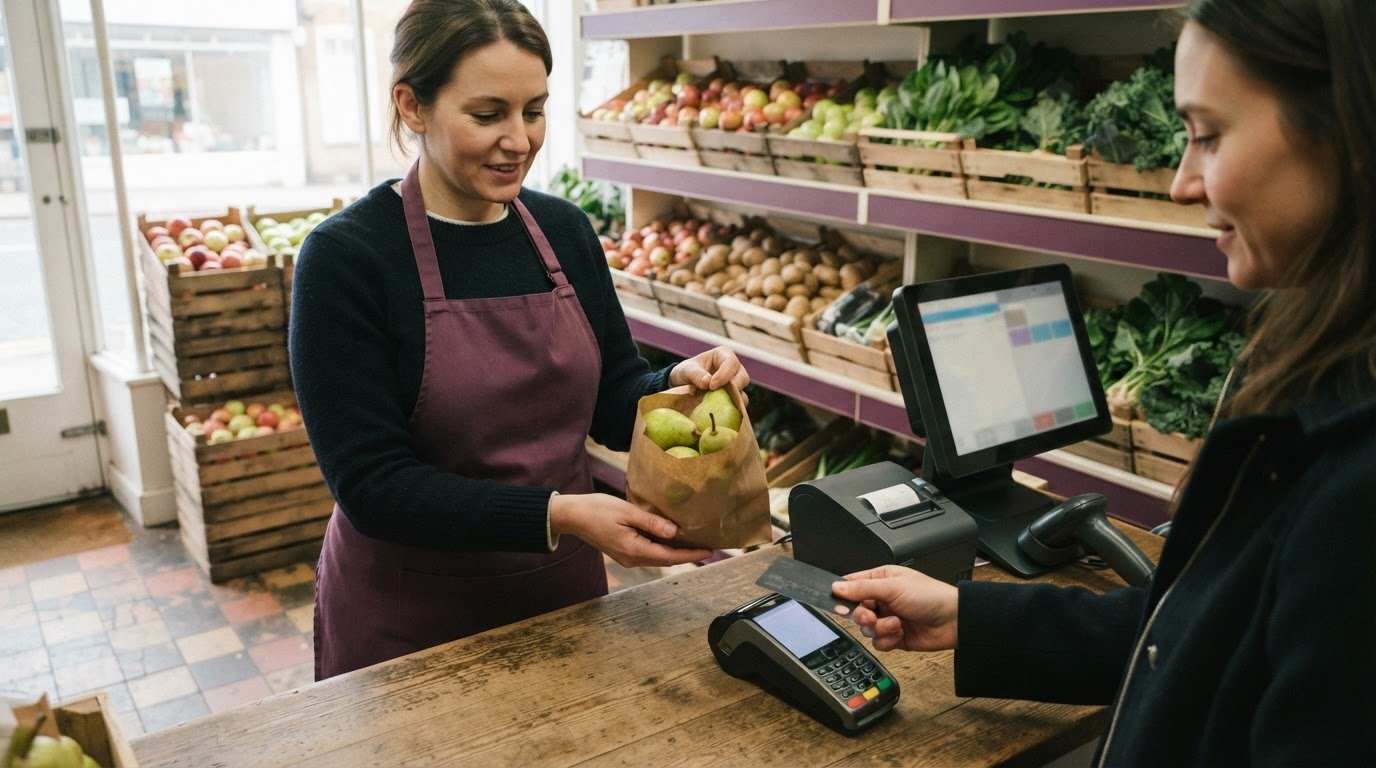

Article by
Chris Niblett
With over 28 years of experience in IT and pre-sales roles, my transition into the hospitality and retail sectors has enabled me to help businesses of all sizes optimise their electronic payments and EPOS systems. My passion for service-driven solutions led me to create PenguinPay, where I provide tailored solutions that drive business success.
Reliable card processing in the UK starts with choosing a payment setup that fits how your customers buy. In person, you may need a card terminal; online, an e-commerce gateway; and for phone orders, a virtual terminal. An integrated EPOS system can connect card payments with till operations.
Payments should work smoothly, but the right setup also needs to suit your sales channels and provide support when issues arise. This guide explains how gateways and processors work, compares ways to accept card payments and outlines what to consider when assessing support. Use these points to decide which setup best fits your day-to-day operations.
Key Takeaways
- Understand how a payment gateway and processor work together to move an online transaction through to payment.
- Match your payment method to how customers buy, whether in person, online or by phone.
- Compare transaction charges, settlement arrangements and support availability to assess what fits your operations.
- Explore how face-to-face card payments or an integrated EPOS system could support your in-person sales.
How online payment gateways and processors work
UK businesses can accept card payments in person, online or remotely. The best route depends on how customers pay and which payment methods your setup supports.
Online card gateways and processing
At checkout, a gateway securely passes payment details from an e-commerce site to the processor. The processor sends the transaction for authorisation and returns an approval or decline to the checkout. For example, a customer paying by credit card sees the result online while the transaction moves through the processing chain. Unlike a card terminal, a gateway handles online payments.
Remote card acceptance
Payment links and virtual terminals let businesses take card payments remotely, without a customer presenting a card at a till. You can send a payment link for online payment, or enter payment details into a virtual terminal during a phone order. These options suit orders taken away from a physical checkout. An e-commerce gateway, by contrast, connects directly to a website.
Processing rates and pricing
Published UK online processing rates may combine a percentage of each transaction with a fixed transaction charge. In-person pricing may follow a different structure, so compare costs like for like across sales channels. Review account and service charges too, and check how transaction types affect the total. A published rate alone does not show the full processing cost.
Contactless and digital wallet payments
Processors may support contactless cards and digital wallets as well as standard card payments. In person, a customer taps a compatible card or device on a terminal; online, a supported wallet may appear as a checkout option. Acceptance depends on the payment setup, so compare the methods available for each channel.
| Option | Setting | Payment route |
|---|---|---|
| Gateway | Ecommerce | Website checkout |
| Payment link | Remote | Customer pays online |
| Virtual terminal | Remote | Details entered for an order |
| Card terminal | In person | Card or device presented |
Choose a payment method that matches where customers pay, then compare the supported methods and full pricing structure.
How can my business accept card payments?
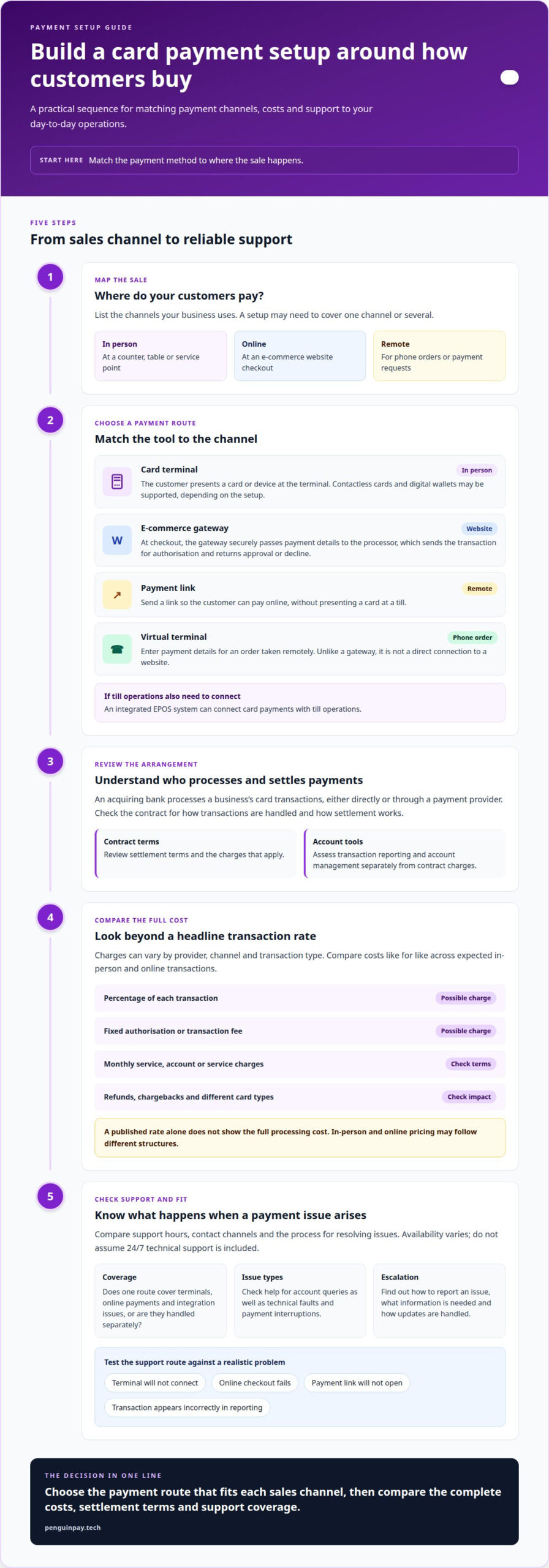
Choose a provider and payment setup that fit your sales channels, then review the acquiring arrangement, contract terms and account tools. For reliable card processing in the UK, assess the complete service rather than relying on a headline rate.
UK card processing providers
No single payment setup suits every UK business. Assess practical factors such as transaction reporting, account management, support routes and coverage of your sales channels. A retailer using a card machine may prioritise in-person support, while an online seller may need e-commerce processing and payment links. Reliable card processing in the UK means matching these capabilities to your operations, not simply choosing a familiar name.
Acquiring bank contracts and fees
An acquiring bank processes a business’s card transactions, either directly or through a payment provider. The contract explains how transactions are handled, how settlement works and which charges apply. Review transaction fees, service charges, chargeback costs and settlement terms together, since they can all affect cash flow. These terms are separate from the provider’s reporting and account-management tools.
Transaction fees and monthly costs
UK processors may charge a percentage per transaction, a fixed authorisation fee, a monthly service charge or a combination. Compare costs across your expected in-person and online transactions. Check how charges apply to refunds, chargebacks and different card types. This gives you a clearer picture than comparing a single headline rate.
Provider support and pricing transparency
PCI DSS concerns card-data security, whilst Strong Customer Authentication concerns verifying certain electronic payments. They address different aspects of payment processing. Compare how clearly the provider explains fees and transaction reports, and what support routes are available for account or technical issues. Discuss your card payment requirements to explore a suitable setup.
Customer support availability
Support matters when you cannot take a card payment, reconcile a transaction or use a terminal. Compare support hours, contact channels and the process for resolving issues. A failed online checkout, for example, may need different troubleshooting from a card machine that will not connect. Clear escalation steps show where a technical issue goes next.
UK-based support can make it easier to discuss local banking processes and business hours. Check whether the team handles account queries as well as technical faults, such as a payment link that will not open or a transaction displayed incorrectly in reporting. Find out whether one support route covers terminals, online payments and integration issues, or whether these are handled separately.
Don’t assume that 24/7 technical support is included. Availability varies, so compare the stated hours and what “technical support” covers: a failed payment, a digital wallet issue, or a connection between an EPOS system and payment processing. Look for a clear distinction between help with a charge or account query and urgent assistance with a payment interruption. This makes the service easier to assess against your trading hours.
Before choosing, map one realistic problem to the support route: a terminal stops accepting contactless payments during service, or an online integration fails during checkout. Note how to report it, what information the merchant needs to provide and how updates are handled. For a setup spanning terminals and digital payments, discuss your payment support requirements and the assistance relevant to your business.
PenguinPay: Face-to-Face Card Payments
PenguinPay provides Face-to-Face Card Payments for businesses taking payments in person. If customers pay at a counter, table or service point, this can cover the in-person part of your payment setup.
If your card payments also need to connect with till operations, consider Fully Integrated EPOS systems. The right arrangement depends on how your business takes payments and manages sales: decide whether you need card payments alone or a more connected EPOS setup. PenguinPay also provides E-commerce gateways for online sales.
Discuss the setup that fits your business by contacting PenguinPay.
Shape a payment setup around your next stage
Reliable card processing in the UK should support how your business plans to operate, not just the transactions it handles today. As your sales channels or daily processes change, keep your payment setup aligned with your priorities. Consider which parts of the customer journey you want to simplify and how payment arrangements can support your plans.
PenguinPay offers Face-to-Face Card Payments, Fully Integrated EPOS systems and Business Banking. These options can be considered around your business needs, whether you’re refining in-person payment acceptance or planning a more connected operation. Think about the experience you want customers and staff to have, alongside the operational priorities that matter most as your business develops. Take the next step at a pace that suits you: Contact PenguinPay about card processing. A thoughtful conversation can help you identify a practical direction for your business.
Frequently Asked Questions
What is payment processing?
Payment processing handles a customer’s card transaction so a business can receive payment. For example, when a customer pays for a meal by card, the transaction is submitted for authorisation and the outcome is recorded. This process connects the customer’s payment method to the business’s payment setup, helping the business track completed and declined transactions.
Can I take payments in person?
Yes. A business can accept card payments at a physical location with a suitable payment terminal. This works for a shop in London, a café in the Midlands or a service business taking payment face to face. If till operations also need to connect with card payments, an integrated EPOS system can bring sales activity together.
Can I take payments without a website?
Yes. You do not need a website for every payment method. A virtual terminal can take payments for orders handled by phone, while a payment link gives customers an online way to pay. These options can suit businesses selling by appointment, invoice or direct conversation rather than through an e-commerce checkout.
How much does it cost?
Payment-processing prices depend on the setup and the way a business takes payments. The price depends on the case and is given after a quote request. Relevant factors include the payment channels involved, transaction activity, contract terms and any applicable service or equipment charges. Consider the full arrangement rather than judging a provider by one rate alone.
What are merchant services?
Merchant services help businesses accept and manage customer transactions. They can include card payment acceptance, a payment terminal, online payment processing or tools for remote orders. For a retailer, these services may support checkout; for a hospitality business, they can form part of the payment process at the point of sale.