

Article by
Chris Niblett
With over 28 years of experience in IT and pre-sales roles, my transition into the hospitality and retail sectors has enabled me to help businesses of all sizes optimise their electronic payments and EPOS systems. My passion for service-driven solutions led me to create PenguinPay, where I provide tailored solutions that drive business success.
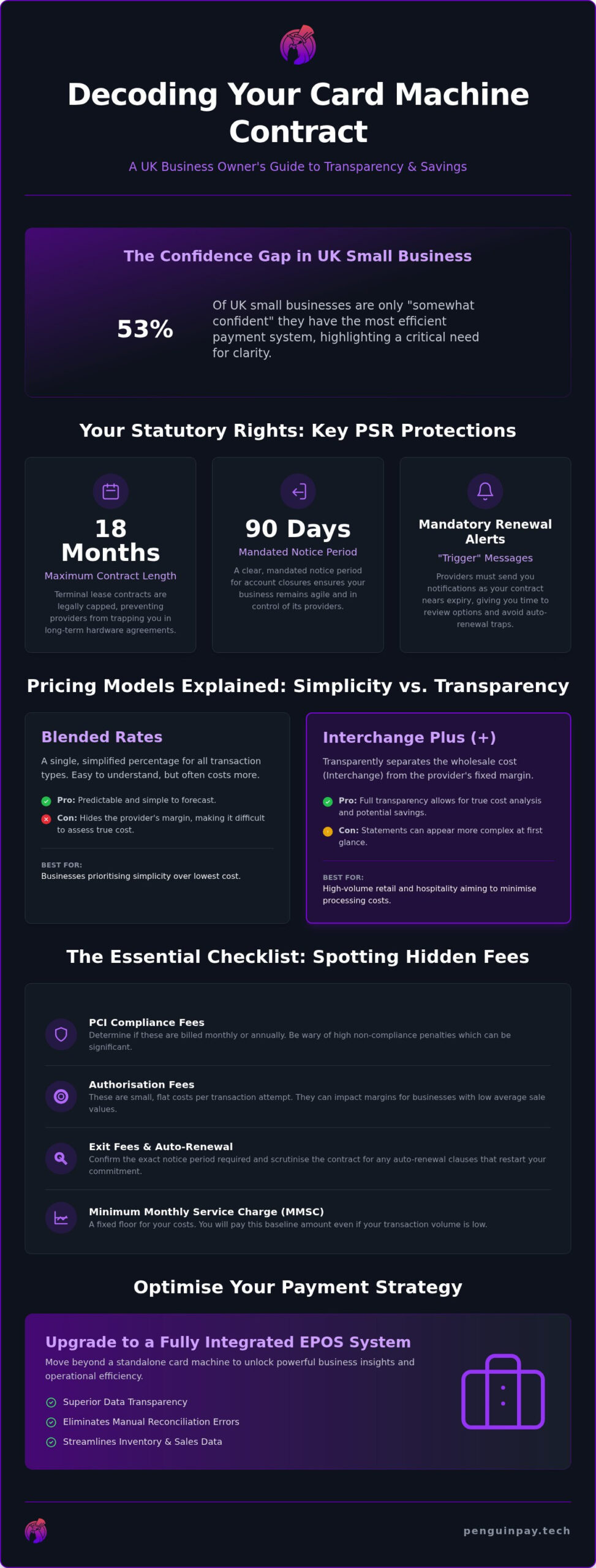
A 2026 survey found that 53% of UK small businesses are only “somewhat confident” they have the most efficient payment system, highlighting why having card machine contracts explained is more critical than ever. It’s a frustrating reality for many, as opaque fee structures often make merchant agreements feel like a minefield. You likely suspect your provider is hiding the true cost of processing, yet comparing like-for-like quotes remains a significant challenge. We believe that transparency should be the standard, not the exception, in every business partnership.
This article provides a consultant-led checklist to help you navigate card machine contracts explained through a lens of advocacy and precision. We will examine your statutory rights and offer a comprehensive guide to vetting new providers using our industry expertise. By the end of this card machine contracts explained guide, you’ll have a clear roadmap to lowering costs and securing more favourable, bespoke terms for your long-term success.
Key Takeaways
- Understand the 18-month legal limit on contract lengths and the mandated 90-day notice periods for account closures to ensure your business remains agile.
- Use our professional checklist to have card machine contracts explained through the lens of transparency, helping you distinguish between “blended” and “Interchange Plus” pricing.
- Discover how switching to a fully integrated EPOS system provides superior data clarity and helps eliminate the hidden fees often found in standalone terminal agreements.
- Learn why partnering with independent consultants in the Midlands and London offers a level of bespoke support and accountability that direct bank sales cannot match.
Deciphering Card Machine Contracts: Legal Protections and PSR Rules
Understanding card machine contracts explained begins with recognising their structure. These agreements are typically tripartite, involving the merchant, an acquirer responsible for fund settlement, and a terminal provider supplying the hardware. This multi-layered approach is often why a Payment Service Provider (PSP) is vital for simplifying the relationship. For years, the UK sector was plagued by opaque pricing and aggressive sales tactics, leaving many owners feeling misled by complex jargon.
The Payment Systems Regulator (PSR), which is currently being consolidated into the Financial Conduct Authority (FCA), has fundamentally reshaped this environment. By 2026, the focus has shifted from restrictive, long-term lock-ins toward transparent, service-oriented partnerships. This regulatory oversight ensures that businesses are no longer at the mercy of predatory terms, allowing for a more strategic approach to payment processing that prioritises long-term growth over quick sales.
The 18-Month Rule: Your Statutory Rights as a Merchant
One of the most significant protections is the PSR mandate limiting terminal lease contracts to a maximum of 18 months. This rule specifically supports eligible businesses, typically those with an annual turnover under £50 million. It prevents the industry’s old habit of trapping small firms in five-year hardware leases that outlasted the technology itself. You now have the right to exit these agreements more frequently, ensuring your hardware remains modern and efficient.
To ensure you aren’t caught in a cycle of rolling renewals, providers are now legally required to send trigger messages. These notifications must be issued as your contract nears its expiry date, giving you ample time to review your options. If you’re looking for reputable payment providers that respect these boundaries, vetting their compliance with these notifications is an excellent starting point. This transparency allows you to organise your finances without the fear of hidden termination traps.
The Essential Merchant Contract Checklist: Spotting Hidden Costs
When you have card machine contracts explained by a specialist, the focus shifts from the headline rate to the ancillary costs that often inflate bills. A primary consideration is the pricing model. Blended rates offer a single percentage for all transactions, providing simplicity at the cost of higher margins. Conversely, Interchange Plus pricing separates the card scheme costs from the acquirer’s margin, offering the precision required for high-volume retail and hospitality sectors. If you’re weighing up a large standardised processor against a more tailored approach, our guide on Worldpay vs independent consultancy explores how these pricing structures differ in practice.
Always verify if the agreement permits mid-term price increases. Many standard bank contracts include clauses that allow providers to adjust rates with minimal notice. A Minimum Monthly Service Charge (MMSC) is a fixed floor for your processing costs, meaning you’ll pay a baseline amount even if your transaction volume is low. Understanding these nuances is vital before signing, and you may find it helpful to speak with a consultant to review your specific terms.
Decoding the Fee Structure: Beyond the Transaction Rate
To avoid unexpected overheads, your review should include these three critical areas:
- PCI Compliance Fees: Determine if these are billed monthly or annually. Be particularly wary of non-compliance penalties, which can be significantly higher than the standard management fee.
- Authorisation Fees: These are flat costs applied to every transaction attempt. Whilst they seem small, they can impact margins for businesses with low average transaction values.
- Exit Fees and Notice Periods: Confirm the exact notice required to terminate. Ensure there are no auto-renewal clauses that could inadvertently restart your 18-month commitment without your consent.
Optimising Your Payment Strategy: Moving Beyond Standard Contracts
A strategic shift in your payment setup often yields better results than simply chasing the lowest headline rate. When you have card machine contracts explained through a strategic lens, the benefits of a fully integrated EPOS system become clear. It provides superior data transparency and eliminates the manual reconciliation errors that plague standalone machines. For merchants in regions like the Midlands or London, selecting reputable payment providers with local, face-to-face support adds a layer of accountability that distant call centres cannot match.
Viewing your agreement as a component of a broader business banking for hospitality strategy ensures your cash flow and terminal terms work in harmony. A consultative approach uncovers nuances and savings that generic comparison sites often overlook.
The Consultant’s Advantage: Bespoke Solutions vs. Rigid Agreements
Independent advisors operate with a level of flexibility that direct sales agents lack. Since they aren’t tied to a single bank’s quota, they can negotiate bespoke terms tailored to your specific sector requirements. This is where having card machine contracts explained by a veteran becomes invaluable. They can perform a detailed merchant statement audit, identifying leverage for your next negotiation. Understanding the full spectrum of your options — from large-scale processors to dedicated advocates — is made easier with a direct comparison of Worldpay vs independent consultancy models and what each delivers for UK hospitality and retail businesses.
Utilising a partner spotlight helps ensure you choose hardware that won’t become obsolete before your term ends. This forward-thinking approach protects your investment. By scrutinising your current processing behaviour, an advisor can secure more flexible exit terms and lower overheads, transforming a standard contract into a strategic business asset.
Securing Your Business Growth Through Transparent Payments
Mastering your merchant agreement is a vital step toward protecting your margins and ensuring operational stability. We’ve seen how the 18-month PSR rule and a diligent fee audit prevent costly oversights, yet the most significant gains often come from a holistic strategy. Having card machine contracts explained by a strategic partner allows you to move beyond rigid bank terms and toward a bespoke system that truly fits your needs.
With 28 years of industry expertise, our team provides independent, service-driven advice specifically for hospitality and retail operators in the Midlands and London. We’re here to help you navigate these complexities with confidence. To ensure your payment infrastructure is fully optimised for 2026, you can book a bespoke payment consultancy session with PenguinPay today. Reclaiming control of your overheads is the first step toward a more resilient and profitable future.
Frequently Asked Questions
Can I cancel my card machine contract early?
You can exit early, but it typically involves paying out the remaining rental months as a termination fee. It’s vital to check if your contract has an auto-renewal clause that might have extended your commitment without a fresh signature. If you’re switching, some reputable providers may offer to subsidise these exit costs to facilitate your transition to a more modern system.
What is the maximum length for a card machine contract in the UK?
Terminal rental contracts are legally capped at 18 months for most UK small businesses. This PSR mandate ensures that hardware leases don’t trap you in outdated technology for years at a time. Whilst the machine lease is capped, your merchant processing account may operate on a rolling monthly basis or a separate fixed term entirely.
Are there hidden fees I should look for in my merchant statement?
Beyond transaction rates, you should scrutinise your statement for “Scheme Fees” and PCI management costs. Scheme fees are paid to Visa and Mastercard, and new 2026 rules require providers to be more transparent about how these are calculated. Having card machine contracts explained helps you identify if your provider is adding an undisclosed margin on top of these mandatory industry costs.
What is the difference between a merchant account and a card machine lease?
A merchant account is the back-end facility that settles card payments into your bank, whereas a card machine lease is the rental agreement for the physical terminal. In a tripartite arrangement, these can be provided by different entities. Understanding this distinction is essential when having card machine contracts explained, as it allows you to choose the best hardware and processing combination for your needs. If you are considering upgrading your setup, our switching EPOS providers guide offers a structured roadmap to help you transition without disrupting your operations or compromising your data integrity.