

Article by
Chris Niblett
With over 28 years of experience in IT and pre-sales roles, my transition into the hospitality and retail sectors has enabled me to help businesses of all sizes optimise their electronic payments and EPOS systems. My passion for service-driven solutions led me to create PenguinPay, where I provide tailored solutions that drive business success.
A successful EPOS transition isn’t just a hardware swap; it’s a strategic audit of your business’s future efficiency. You’ve likely invested years into your customer data and inventory logs, making the prospect of a migration feel like a gamble with your most valuable assets. Between the fear of peak-hour downtime and the complexity of contract notice periods, it’s understandable why many firms delay necessary upgrades. However, staying tethered to a legacy system often means overpaying for transaction fees and missing out on vital automation.
This switching EPOS providers guide offers a professional roadmap to help you master these complexities whilst maintaining absolute data integrity. We’ll provide a structured checklist for a pain-free transition that lowers your overheads, improves reporting accuracy, and ensures your systems are fully aligned with the 2026 Making Tax Digital requirements for self-assessment.
Key Takeaways
- Conduct a thorough audit of your current operational challenges and review existing merchant agreements to identify hidden exit fees or lengthy notice periods before committing to a change.
- Prioritise fully integrated EPOS systems that synchronise your till and card terminal, whilst ensuring data integrity by requesting a sample export to verify CSV or Excel compatibility.
- Utilise this switching EPOS providers guide to strategically time your transition during low-volume trading windows, effectively eliminating the risk of downtime during peak hours.
- Invest in comprehensive staff training amongst all team members to ensure a seamless adoption of the new interface and to maximise the benefits of improved reporting tools.
Auditing Your Current Setup and Navigating Contractual Obligations
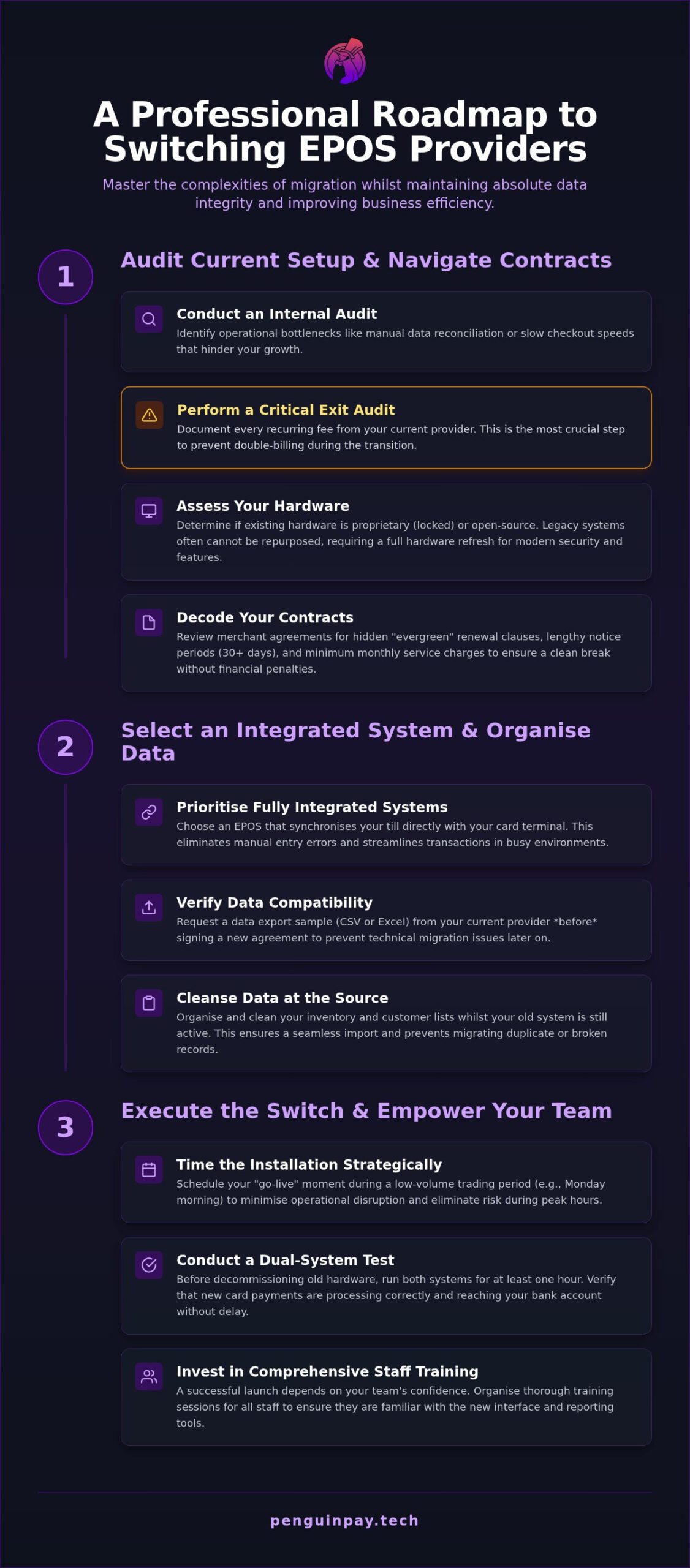
Before exploring new software, you must understand the nuances of your current environment. This switching EPOS providers guide begins with a thorough internal audit to identify the specific operational bottlenecks, such as manual data reconciliation or lagging checkout speeds, that hinder your growth. An exit audit is the most critical step in avoiding double-billing during a transition. By documenting every recurring fee, you ensure no legacy costs slip through the cracks during the migration phase.
It’s also essential to determine whether your existing hardware is proprietary or open-source. Whilst some modern tablets can be repurposed, many legacy systems in regions like Nottingham and Leicester use locked hardware that won’t communicate with a new provider. Understanding What is an EPOS system? in its modern, integrated context helps you decide whether a full hardware refresh is more cost-effective than attempting to patch old equipment that may lack the security features required in 2026.
Decoding Card Machine Contracts and Notice Periods
Many UK businesses find themselves trapped by “evergreen” clauses that automatically renew a contract for another year without explicit consent. You should verify if your card terminal is bundled with your EPOS software; these agreements often have different termination dates, leading to unexpected exit fees if you cancel one but not the other. We’ve detailed how to spot these hidden costs in our guide on Card Machine Contracts Explained.
For businesses in Derby or London, where competition is high, being tethered to an outdated contract can stifle your ability to adopt better transaction rates. Review your merchant agreement for “minimum monthly service charges” and notice periods that can range from 30 days to several months. Identifying these legal ties early empowers you to negotiate a cleaner break and transition to a more flexible partner without financial penalty. If you’re weighing up the merits of a large-scale processor against a dedicated advocate, our analysis of Worldpay vs independent consultancy can help you determine which payment strategy delivers the best long-term value for your business.
Selecting a Fully Integrated System and Organising Data Migration
Choosing the right platform is the pivot point of your transition. This switching EPOS providers guide recommends prioritising systems that offer Fully Integrated EPOS capabilities. By synchronising your till directly with your card terminal, you eliminate the risk of manual entry errors that often plague busy hospitality and retail environments. Before signing a new agreement, request a data export sample from your current provider. Verifying CSV or Excel compatibility now prevents a technical stalemate later.
It’s vital to organise your inventory and customer lists whilst your old system is still active. Cleaning your data at the source ensures a seamless import, preventing duplicate records or broken categories from migrating to your new digital environment. If your transition involves significant operational shifts or staff changes, you should also consider any contractual obligations under TUPE to ensure your team’s rights are protected during the handover process.
The Consultant’s Approach to Bespoke Implementation
Bespoke solutions tailored to your specific niche consistently outperform generic, off-the-shelf products. A strategic partner will map your legacy data fields to the new system centre, ensuring your historical reporting remains accurate and actionable. Working with a trusted card payment consultancy UK businesses rely on can help you identify the right integration for your workflow and uncover hidden merchant fees before they erode your margins. We recommend reviewing our partner spotlight to identify vetted hardware providers that align with your business goals. If you’re unsure which integration best suits your workflow, you can speak with a specialist for tailored advice.
Executing the Switch: Installation, Training, and Post-Launch Optimisation
The final phase of this switching EPOS providers guide focuses on the “go-live” moment. To minimise operational disruption, you should schedule your installation during a low-volume trading period, such as a Monday morning or a mid-week afternoon. Before decommissioning your old hardware, conduct a dual-system test for at least one hour. This allows you to verify that card payments are processing correctly and reaching your bank account without delay. Throughout this process, ensure your handling of historical records aligns with official data protection and GDPR guidance to maintain compliance.
Confidence amongst your team is the foundation of a successful launch. You must organise comprehensive training sessions for all staff members to familiarise them with the new interface. Whilst remote assistance is common, “on-site support in the Midlands and London provides a safety net that remote-only providers cannot match.” This local presence ensures that any teething issues are resolved in person, which is why following a dedicated switching EPOS providers guide remains essential for maintaining operational continuity during the handover.
Post-Migration Support and System Optimisation
The transition doesn’t end once the hardware is installed. You should carefully monitor your first merchant statement after the switch to confirm that the agreed transaction rates and fees are being applied correctly. It’s also beneficial to schedule a follow-up consultation to review advanced reporting features and identify further efficiency gains. For ongoing hardware maintenance and peace of mind, we recommend working with certified providers who understand the nuances of your specific industry.
Future-Proofing Your Point of Sale Operations
Transitioning to a modern platform is a strategic milestone that rewards your business with enhanced accuracy and staff confidence. By auditing your current contractual obligations and prioritising fully integrated EPOS systems, you safeguard historical data whilst reducing manual reconciliation errors. This switching EPOS providers guide has provided the methodical framework required to ensure your migration serves as a catalyst for growth rather than a cause for operational downtime.
At PenguinPay, we leverage over 28 years of IT expertise to provide bespoke consultancy for retail and hospitality leaders across London and the Midlands. As a specialist in fully integrated EPOS, we offer the technical precision and personalised support necessary for a seamless transition. To secure your operational continuity, you can book a bespoke EPOS consultation with PenguinPay today. We look forward to helping you build a more efficient, future-ready business.
Frequently Asked Questions
How long does it typically take to switch EPOS providers in the UK?
A standard transition typically takes between two and four weeks from the initial consultation to your final go-live date. This timeline allows for a thorough audit, hardware delivery, and bespoke configuration. For businesses in Nottingham, Leicester, or London, choosing a local partner can often expedite the physical installation. Following a structured switching EPOS providers guide ensures that each phase remains on schedule without compromising your operational continuity.
Will I lose my historical sales and tax data when I switch systems?
You won’t lose your data if you manage the migration with technical precision. Most modern systems allow you to export historical records into CSV or Excel formats for secure archiving. This is particularly vital for the 2026 Making Tax Digital requirements for self-assessment. We recommend keeping your old system active for a short overlap period to ensure all tax records are successfully reconciled before you decommission the legacy software.
Can I keep my current card machine if I change my EPOS software?
It’s usually not possible to keep your existing terminal if you are moving to a Fully Integrated EPOS system. Integrated solutions require specific software handshakes between the till and the card reader to eliminate manual entry errors. Whilst some standalone terminals might technically function, they won’t offer the efficiency gains or the seamless reporting that define a bespoke, modern payment infrastructure tailored to your specific niche.
What are the common hidden costs when switching to a new EPOS provider?
Common hidden costs include early termination fees from your current merchant agreement and specific data migration charges for complex inventory lists. You should also account for staff training time and potential hardware shipping costs. Reviewing your contract for “minimum monthly service charges” is essential before signing a new deal. A professional switching EPOS providers guide helps you identify these liabilities early, preventing unexpected hits to your cash flow.