
Article by
Chris Niblett
With over 28 years of experience in IT and pre-sales roles, my transition into the hospitality and retail sectors has enabled me to help businesses of all sizes optimise their electronic payments and EPOS systems. My passion for service-driven solutions led me to create PenguinPay, where I provide tailored solutions that drive business success.
An off-the-shelf EPOS package may look straightforward until orders have to move between the dining room, kitchen and payment point. Restaurant EPOS experts start by understanding how your service works, then help you compare systems against the tasks your team needs to complete.
If you’re weighing up consultancy against choosing a package yourself, the decision comes down to how clearly you can define your requirements and compare them with the system’s functions. Consider how orders are taken and amended, where customers pay, and whether you serve diners on-site, takeaways or both. This guide explains how to compare those needs and what to discuss with an adviser. PenguinPay takes a consultative approach, drawing on Chris Niblett’s more than 28 years of IT and pre-sales experience to help you assess EPOS and payment options.
Key Takeaways
- Compare choosing a packaged system yourself with mapping your requirements first; the right route depends on how your restaurant operates.
- Use your service model, busiest periods and staff workflows to prioritise the EPOS capabilities that matter most.
- Restaurant EPOS experts can help you assess how ordering, reporting and payments should fit together.
- Prepare to describe your venue, current payment flow and future plans so you can compare suitable approaches clearly.
Restaurant EPOS experts or off-the-shelf systems: what suits your operation?
Should you compare packaged EPOS systems yourself, or map your restaurant’s requirements with an expert first? A venue with one service style, a single payment point and few exceptions may be able to shortlist systems against a simple set of needs. If your restaurant combines table service with takeaway orders, handles payments in different places or plans to open another site, there are more workflows to account for before choosing.
EPOS brings together the hardware and software used to process transactions. A point of sale (POS) system, also known as an Electronic Point of Sale (EPOS) system, manages retail transactions, including in restaurant settings. The important question is how well a particular setup fits your ordering, service and payment flows. A packaged system can make it easier to compare stated features and select a standard setup. Consultancy helps you define the requirements first and weigh up EPOS configuration alongside connected payment needs. Neither route suits every restaurant.
When does restaurant EPOS consultancy add practical value?
Consultancy is particularly useful when orders pass through several stages, customers pay at different points, or you’re considering new sales channels or sites. These factors affect how staff use the system during a busy service. Before comparing options, trace a typical order from the moment it is placed through to payment. Note where staff amend orders, where information needs to go next and which steps currently cause delay or duplication. That makes it easier to separate essential functions from features that would add little to your operation.
PenguinPay’s consultative approach starts with your operational requirements rather than a predetermined package. The discussion can cover your venue, service pattern, payment needs and plans, helping you compare suitable EPOS and card payment approaches. Chris Niblett brings more than 28 years of IT and pre-sales experience to that process. For broader context on system components and applications, explore this fully integrated EPOS systems guide.
How to compare restaurant EPOS options against your service needs
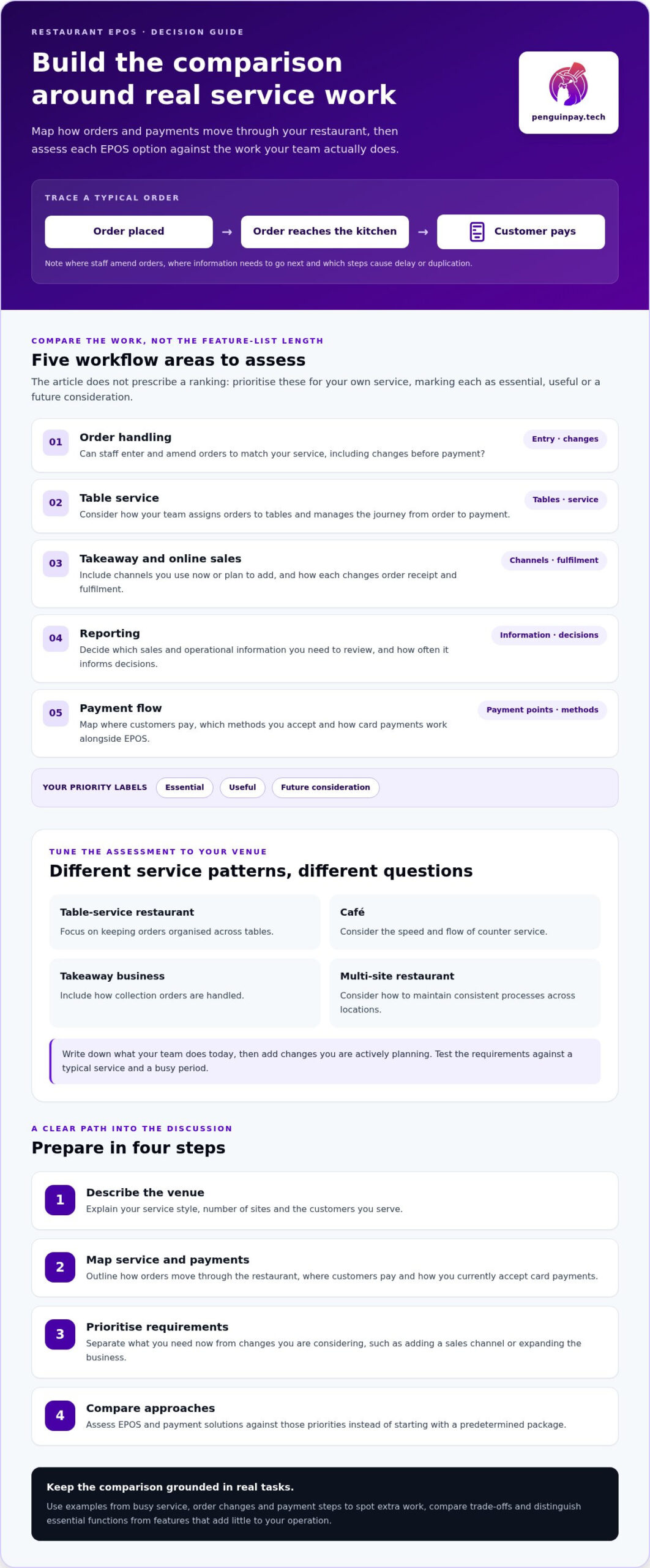
Compare systems against the work your team actually does, not the length of a feature list. First, write down where orders begin, how they reach the kitchen and when customers pay. Then use the same requirements to assess each option. This keeps useful functions in focus and makes it easier to spot gaps in the everyday workflow.
- Order handling: Check whether staff can enter and amend orders in a way that matches your service. Include common changes, such as updating an order before it is paid for.
- Table service: Consider how your team assigns orders to tables and manages the steps from taking an order to completing payment.
- Takeaway and online sales: Include these channels if you use them now or plan to add them. Note how each channel changes the way orders are received and fulfilled.
- Reporting: Decide which sales and operational information you need to review, and how often you use it to make decisions.
- Payment flow: Map where customers pay, which payment methods you accept and how card payments need to work alongside EPOS.
Mark each requirement as essential, useful or a future consideration. Think through a typical service as well as a busy period: who enters orders, who handles changes and where do staff or customers encounter extra steps? Use those examples to compare options and discuss any trade-offs. A feature is only valuable if it supports a real task or a planned change.
Which EPOS questions matter for your restaurant type?
A table-service restaurant may need to focus on keeping orders organised across tables, while a café may prioritise a quick counter flow. A takeaway business should include collection orders in its assessment, and a multi-site restaurant may want to consider how it will maintain consistent processes across locations. Write down what your team does today, then add changes you are actively planning. This UK hospitality EPOS systems guide offers further context for assessing features against your venue.
Restaurant EPOS experts can help turn that list into a practical comparison of EPOS and card payment approaches. If you’d value a structured discussion of your requirements, talk through your restaurant’s EPOS needs.
What restaurant EPOS experts can help you decide next
A useful EPOS discussion should clarify what you need, not leave you with a longer list of features. Before the conversation, prepare a short description of your venue and the points where orders or payments become difficult to manage. Then work through your requirements in order:
- Describe the venue: Explain your service style, number of sites and the customers you serve.
- Map service and payments: Outline how orders move through the restaurant, where customers pay and how you currently accept card payments.
- Prioritise requirements: Separate what you need now from changes you’re considering, such as adding a sales channel or expanding the business.
- Compare approaches: Assess EPOS and payment solutions against those priorities instead of starting with a predetermined package.
PenguinPay provides bespoke EPOS and payment consultancy to help hospitality businesses identify and implement solutions around their operational requirements. The company works with businesses across London, Greater London, Nottingham, Leicester, Chesterfield, Derby, Lincoln, Grantham, Derbyshire, Nottinghamshire, Leicestershire, Lincolnshire, Staffordshire and the Midlands. For a restaurant, the aim is to bring the relevant decisions into focus so you can compare options against your service and plans.
How does a needs-led EPOS conversation move the decision forward?
Bring real examples: a busy service when orders need to move smoothly, a payment step that creates extra work, or a planned change that could affect your setup. These details give you a concrete basis for discussing what the system needs to support. Chris Niblett draws on more than 28 years of IT and pre-sales experience to help make sense of your requirements and compare suitable approaches. Once you’ve chosen an option, planning the next steps helps keep the change focused on the needs you identified. Restaurant EPOS experts can make the decision process more structured, with your operation at its centre.
If you’re ready to turn your priorities into a considered EPOS and payment discussion, share your restaurant’s requirements.
Take the next step towards a better-fitting EPOS system
Before choosing a system, set out what you need your EPOS and payment arrangements to support during a typical service and as your plans develop. A clear brief helps keep comparisons focused on practical priorities. Include your order flow, payment points, staff workflows and any changes you expect to make, then use those details to assess suitable approaches.
PenguinPay’s bespoke EPOS and payment consultancy is shaped around your requirements. Chris Niblett brings over 28 years of IT and pre-sales experience to the conversation, helping you clarify the decisions and consider options that fit your operation.
Discuss your restaurant’s EPOS and payment requirements with PenguinPay to take a considered step towards a setup that fits your service.
Frequently Asked Questions
Are restaurant EPOS experts worth consulting?
Consultancy can be useful if your restaurant has several service routes, changing payment needs or plans that could make a poor system fit disruptive. Restaurant EPOS experts can help organise requirements and compare approaches without assuming that the most elaborate system is best. If your operation is straightforward and your needs are clear, you may be comfortable comparing packaged systems against a short list of requirements.
What should a restaurant EPOS system do?
An EPOS system records sales and supports the flow from taking an order through to completing the transaction. The relevant functions depend on how you serve customers: table service, takeaway and online sales can involve different processes. Consider a real example, such as changing an order before payment, and assess how well each option’s stated workflow accommodates it.
How do I choose between an EPOS consultant and an off-the-shelf system?
A packaged system may suit you if your requirements are clear and you’re comfortable assessing its stated functions. Consultancy can help if you’re unsure how your needs fit together or want to weigh up trade-offs. Before deciding, note a typical service, a particularly busy period and a planned business change. This brief helps show whether you need support defining the requirements or are ready to compare packages directly.
Can restaurant EPOS and card payments be considered together?
Yes. Treat taking an order and accepting payment as connected parts of the customer journey, then consider where each happens, such as at a counter, table or online. Your sales channels and operating routines shape what you need from the setup. PenguinPay provides bespoke EPOS and payment consultancy for businesses in London, Nottingham, Leicester and across the Midlands, helping align options with your stated requirements.