

Article by
Chris Niblett
With over 28 years of experience in IT and pre-sales roles, my transition into the hospitality and retail sectors has enabled me to help businesses of all sizes optimise their electronic payments and EPOS systems. My passion for service-driven solutions led me to create PenguinPay, where I provide tailored solutions that drive business success.
What if the advertised card rate isn’t the part of your bill you can change? If you’re trying to reduce card processing fees, it’s natural to focus on the percentage you were quoted. But statements can include several different costs, and the headline rate may not reflect what you pay across every transaction or payment channel.
Start by separating interchange, scheme fees and the acquirer’s markup. Some costs are set elsewhere; the markup is the part you can negotiate. This guide explains how the charges fit together, challenges common fee-reduction myths and sets out practical steps based on your transaction mix and operations. It also explains how to compare pricing models and assess your payment setup without rushing into a change that disrupts the way your business takes payments.
Key Takeaways
- To reduce card processing fees, start with your statements: group charges and map them to the payment channels that generate them.
- Separate avoidable costs from charges set by card schemes or other parties before deciding what to query.
- Compare transaction patterns and service needs before considering contract changes, so potential savings don’t come at the expense of payment operations.
- Assess the whole setup, including total charges, integrations and contract terms. Switching providers alone doesn’t guarantee a better fit.
Reduce card processing fees by understanding what you actually pay
Reducing card processing fees means managing avoidable costs without weakening the payment operations your business relies on. Start by separating the charges in your agreement and statements. A single headline rate may combine costs that arise for different reasons.
Interchange is a fee associated with a card transaction, typically paid to the cardholder’s bank. Card schemes set their own fees for using their networks, whilst your payment provider or acquirer charges for processing and related services. The UK guide to payment processing explains these components in more detail. For a broader explanation of the interchange fee, see the background on how it works internationally. Your agreement may bundle charges into a blended rate or show them separately, so compare the same types of costs when reviewing different offers.
The overall cost depends on more than the rate. Card type, transaction channel, payment method, contract terms and included services can all affect your statement. A retailer taking in-person payments and an online business accepting cards from overseas, for example, may have different transaction mixes and service needs. Group charges by channel and compare like with like before deciding which ones to investigate.
Myth: the lowest advertised rate means the lowest total cost
A headline rate may not include every charge or explain the service terms behind it. Review your merchant agreement and statements for provider fees, fixed or per-transaction charges, and other applicable terms. A headline rate alone cannot establish your total processing cost; only the full charges and service terms show what you pay. A careful review is more reliable than choosing a payment arrangement on its advertised percentage alone.
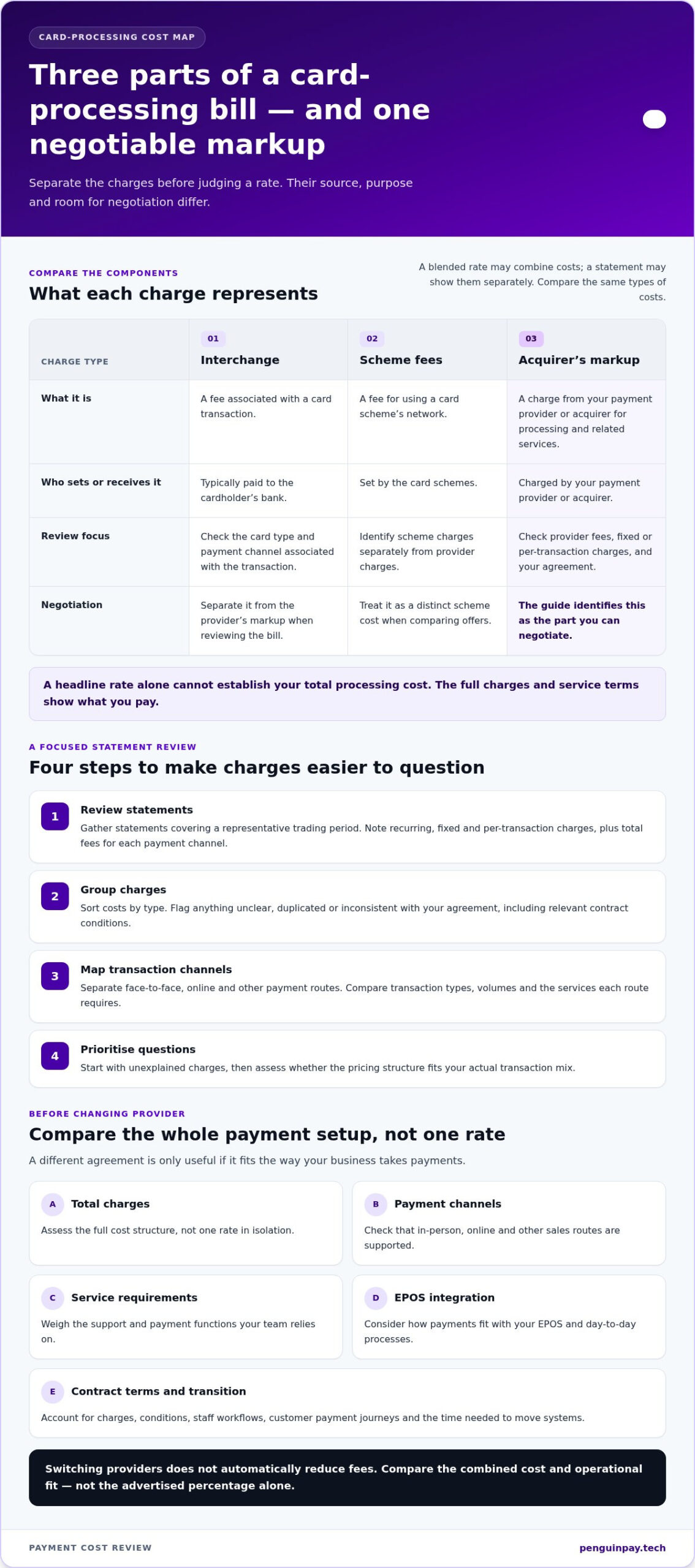
How to reduce card processing fees with a focused UK business review
A structured review helps distinguish charges worth querying from costs that reflect how your customers pay or the services your business needs. Before discussing contract changes, build a clear picture of your current setup.
- Review statements: Gather statements covering a representative trading period. Note recurring, fixed and per-transaction charges, and record the total fees for each payment channel.
- Group charges: Sort charges by type and flag anything unclear, duplicated or inconsistent with your agreement. Include contract conditions, as these can affect what you pay.
- Map transaction channels: Separate face-to-face, online and other payment routes. Compare transaction types, volumes and the services each route requires.
- Prioritise questions: Start with unexplained charges, then assess whether the pricing structure fits your actual transaction mix.
Which cost levers are worth reviewing first?
Start with avoidable or unclear charges, then separate them from costs associated with card type, channel or agreed services. Check that transaction records are accurate and review chargebacks and payment processes for patterns that may merit attention. These checks can support an informed discussion, but no single operational change guarantees lower fees. Keep the full card machine contract terms in view, including applicable charges and conditions.
Consider batching and payment routing in the context of how your systems work and how transactions are processed. Neither is a universal saving tactic. Assess any change to customer-facing payment options carefully: verify relevant UK requirements before introducing it, and weigh any potential cost effect against customer experience and operational impact.
Once you’ve matched charges to channels and requirements, raise specific, evidence-based questions in a provider discussion rather than seeking a lower rate in isolation. A tailored payment setup review can help relate fees to the way your business operates.
Reduce card processing fees without sacrificing the right payment setup
A lower quoted rate is only useful if the overall arrangement supports the way your business takes payments. Before switching, compare options against the same practical criteria:
- Total charges: Assess the full cost structure, not one rate in isolation.
- Payment channels: Check whether the arrangement works across your in-person, online and other sales channels.
- Service requirements: Weigh the support and payment functions your team relies on.
- Integration: Consider how payments fit with your EPOS and day-to-day processes.
- Contract terms: Account for charges, conditions and the practicalities of making a change.
Changing providers doesn’t automatically reduce card processing fees. A new agreement might look more attractive on one measure but fit poorly with existing systems or create extra work during the transition. Consider staff workflows, customer payment journeys and the time needed to move systems alongside the proposed pricing. The right decision depends on the combined cost and operational fit, not the headline rate alone.
When is a payment-system review more useful than switching?
A structured review can help when charges are difficult to interpret, sales are expanding into new channels or your EPOS integration no longer matches the way the business operates. For example, a hospitality business may prioritise a smooth service workflow, whilst a retailer or eCommerce business may need to assess different payment channels and system connections. These operational details can shape which options are worth comparing.
PenguinPay takes a consultative approach to aligning card payment and fully integrated EPOS solutions with hospitality, retail and eCommerce workflows. For businesses in London and Greater London, Nottingham, Leicester, Chesterfield, Derby, Lincoln and Grantham, as well as Derbyshire, Nottinghamshire, Leicestershire, Lincolnshire, Staffordshire and the Midlands, a tailored assessment can help clarify trade-offs and inform your next steps. The right choice depends on your requirements, not an assumption that a provider change or particular setup will deliver a specific saving.
Make your next payment decision with confidence
Turn your fee review into a clear decision brief: what your business needs from payments now, what may change as it grows, and which trade-offs matter most. This gives you a practical basis for improving your setup, whether you stay with your current arrangement or explore alternatives. The aim isn’t to chase the lowest rate at any cost. It’s to find an arrangement that supports your operations whilst helping you identify realistic ways to reduce card processing fees.
PenguinPay’s consultative payment and EPOS solutions are tailored to UK hospitality, retail and eCommerce businesses. Founder Chris Niblett brings more than 28 years of IT and pre-sales experience to understanding how payment choices fit individual operations.
Discuss a payment setup tailored to your business and take your next step with clarity and confidence.
Frequently Asked Questions
Can I negotiate my card processing fees with my provider?
Yes. The provider’s processing markup may be negotiable, especially if you can present a clear picture of your trading profile. Bring recent statements, transaction volumes, chargeback history and a competing written quote to the discussion. Ask how a revised offer affects fixed charges or minimums as well as the rate, so a concession in one area doesn’t obscure new costs elsewhere.
Do debit card payments always cost less to process than credit card payments?
Not always. For UK domestic consumer transactions, interchange is capped at 0.2% for debit and 0.3% for credit, but interchange is only one part of what a business pays. Commercial cards aren’t covered by those caps, and provider pricing and transaction channel also affect the total. Compare your actual transaction mix rather than assuming debit is invariably cheaper.
Can a UK business charge customers extra for paying by card?
Generally, no for personal debit and credit cards: UK businesses can’t add a surcharge for customers paying with consumer cards. Commercial card surcharges are permitted, but mustn’t exceed the business’s cost of processing that payment. Before applying a charge, distinguish commercial from consumer cards and ensure the amount reflects the relevant processing cost. Don’t treat a blanket card fee as an equivalent option.
Will switching payment providers automatically reduce card processing fees?
No. A switch can change pricing, but it may also involve contract exit terms, integration work and adjustments for staff or customers. A Leicester retailer with in-person and online sales, for example, should compare how both channels and its EPOS workflow would function under the alternative. Assess switching against your needs rather than treating it as a guaranteed way to reduce card processing fees.